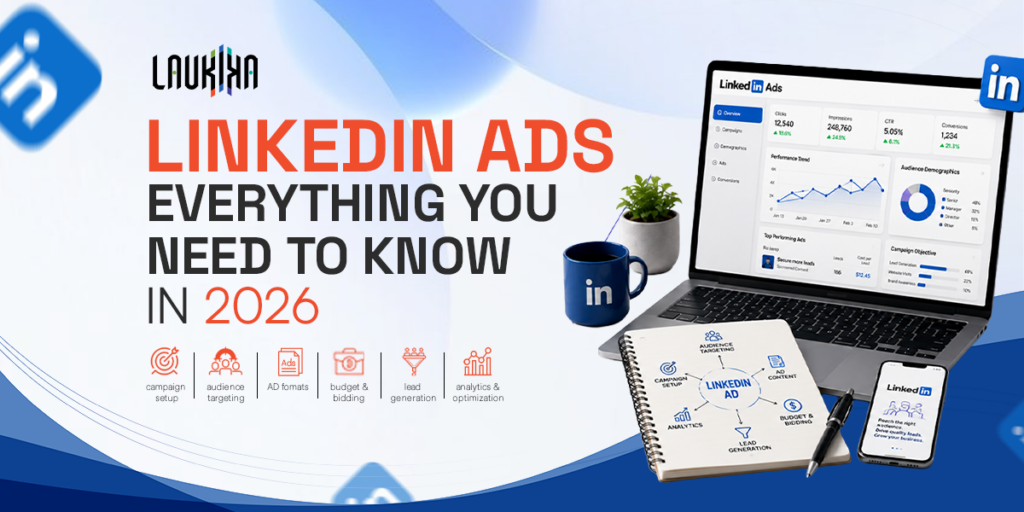
LinkedIn Ads Everything You Need to Know in 2026
- July 23, 2026
- Shiva
- No Responses
LinkedIn is no longer a platform where brands simply boost corporate posts and wait for enquiries. For marketers learning how to run ads on LinkedIn, success now depends on audience quality, creative relevance, accurate tracking and a realistic understanding of the B2B buying journey.
Its biggest advantage is professional data. Advertisers can reach people according to their role, seniority, skills, industry and employer rather than relying mainly on personal interests.
That precision comes at a price. LinkedIn campaigns often cost more than campaigns on consumer platforms. However, the value of a lead can also be considerably higher. This guide explains how to plan, launch and improve LinkedIn advertising campaigns in 2026.
What Is LinkedIn Advertising and Why Does It Work Differently in B2B
LinkedIn advertising is a paid media system that allows businesses to promote content, services, events and lead-generation offers to professional audiences using verified workplace information such as job title, company, seniority, industry, skills and organisation size.
Unlike most social advertising, B2B LinkedIn ads are designed around professional identity and business intent.
Professional context:
People open LinkedIn to follow industries, build careers and learn from peers. Relevant business content therefore feels less disruptive.
Work-based audience data:
Campaigns can reach finance directors, procurement managers or technology leaders without relying entirely on inferred consumer behaviour.
Multiple decisionmakers:
A business purchase may involve users, department heads, finance teams and senior leadership. LinkedIn can reach each group separately.
Longer conversion journeys:
Many prospects will not request a demo after seeing one advertisement. They may need educational content, proof and repeated exposure first.
Higher potential lead value:
Clicks can be expensive, but a qualified enquiry from the right company may justify the investment.
How to Run Ads on LinkedIn Using Campaign Manager
Access LinkedIn Campaign Manager
Sign in to Campaign Manager, create an advertising account and connect the relevant company page. Confirm the account currency carefully because it may not be changeable later. Add billing details and give the required team members access.
Choose Your Campaign Objective
Select the result LinkedIn should optimise for. Options may include awareness, website visits, engagement, video views, lead generation and website conversions.
Choose one that reflects the real campaign goal. A traffic objective may generate visits, but it is not automatically the best choice when qualified enquiries are the priority.
Build Your Target Audience
Define the location first, then add professional criteria such as role, function, seniority, industry or company size.
Avoid adding every possible filter. An audience that is too narrow may struggle to deliver, while a broad audience can waste spend. Begin with the characteristics that genuinely separate a suitable buyer from an unsuitable one.
Select Your Ad Format
Choose a format according to the message. A single image works well for a direct proposition. Video can explain an unfamiliar service. Document ads suit guides, reports and presentations.
The format should support the idea rather than decorate it.
Set Your Budget and Bid Strategy
Choose a daily or lifetime budget and review LinkedIn’s estimated results. Automated bidding is suitable when the platform has enough conversion data. Manual bidding offers greater control but needs closer monitoring.
Set a test budget large enough to produce useful evidence.
Create Your Ad Creative
Write for a busy professional. State the problem, explain the value and make the next step obvious.
Avoid squeezing several benefits into one advertisement. One clear idea is easier to understand and easier to test. The image, headline, body copy and call to action should all support the same message.
Launch, Monitor, and Optimise
Confirm that the advertisement is approved, receiving impressions and sending visitors to the correct destination. Test forms and conversion events yourself.
After launch, check delivery on Day 1 and Day 3 for technical issues. Make performance decisions weekly, not daily. Change one variable at a time, whether it is the creative, audience or bid. Most campaigns need around 10 to 14 days before their results become stable enough for useful conclusions.
Every LinkedIn Ad Format You Need to Know in 2026
Single Image Ads
Single image ads appear naturally in the feed and support awareness, traffic and conversion campaigns. They work best when the visual communicates one recognisable problem, benefit or point of view.
Video Ads
Video ads are useful for demonstrations, interviews, customer stories and complex ideas. Since many people watch without sound, captions are essential. The opening seconds should make the subject immediately clear.
Carousel Ads
Carousel ads contain multiple cards that users can swipe through. They are suitable for explaining steps, presenting product features or developing a short visual narrative.
Each card should move the story forward. Repeating the same message nine times rarely improves performance.
Document Ads
Document ads allow people to read a PDF, report, guide or presentation without leaving LinkedIn. They are especially useful when the audience needs practical information before considering a sales conversation.
A strong cover page matters because it determines whether the user continues reading.
Event Ads
Event ads promote webinars, conferences, workshops and LinkedIn Events. They work best when the topic, speaker and audience benefit are specific.
“Join our webinar” is weak. “Learn how finance teams can reduce month-end reporting delays” gives the reader a reason to register.
Thought Leader Ads
Thought Leader Ads promote eligible posts published by individuals. They allow companies to extend the reach of expert commentary, executive perspectives and employee-led content.
The format feels more personal than a traditional corporate advertisement, but the original post still needs a credible idea.
Sponsored Message Ads
Sponsored Message Ads deliver promotional communication through LinkedIn Messaging. They may be useful for event invitations, high-value offers and selected account lists.
Keep the message brief. Direct access to someone’s inbox should not become an excuse for a lengthy sales pitch.
Text Ads and Dynamic Ads
Text Ads are compact desktop placements containing a headline, short description and image. They are generally used for economical reach and website traffic.
Dynamic Ads can personalise selected elements using profile information. Their visibility is limited compared with feed formats, but they can support broader campaigns.
Connected TV Ads
Connected TV Ads extend B2B advertising into streaming environments. They are more relevant to brand-building campaigns than immediate lead generation.
This format may suit larger advertisers that already understand their audience and can measure results across several channels.
How to Use LinkedIn Campaign Manager to Run Better Ads
LinkedIn Campaign Manager is not only a campaign creation tool. Used properly, it provides the structure needed to manage audiences, budgets, tests and conversions without losing sight of the business objective.
Account Structure in Campaign Manager
The platform is organised into advertising accounts, campaign groups, campaigns and advertisements. Use a consistent naming system that identifies the market, objective, audience and date.
Clear organisation becomes important once several campaigns are active.
Accelerate vs Classic Campaigns
Accelerate campaigns use LinkedIn’s automation to simplify setup and optimise delivery. Classic campaigns provide more manual control.
Automation can save time, but marketers should still review targeting suggestions, creative choices and conversion signals rather than accepting every recommendation.
Conversion Tracking Setup
Install the LinkedIn Insight Tag and define the actions that matter, such as form submissions, registrations or booked consultations.
Test the conversion before launch. An unverified tracking setup can make a successful campaign appear ineffective.
Audience Templates and Matched Audiences
Audience templates provide a starting point for common professional groups. Matched Audiences can be built from website visitors, contact lists, company lists and previous engagement.
These tools are particularly valuable for retargeting and account-based campaigns.
Campaign Manager Reporting and Analytics
Review reach, frequency, click-through rate, conversions and cost per result. Then connect advertising data with CRM outcomes.
A low-cost lead is not necessarily valuable. The more useful question is whether the campaign generated suitable opportunities.
LinkedIn Ads Targeting Options Explained for 2026
The depth of LinkedIn ads targeting options is one of the platform’s strongest advantages. However, precision does not mean combining every filter available.
Professional Attribute Targeting
Advertisers can target members using attributes such as job function, title, seniority, skills and experience. Job titles are specific but inconsistent. Job functions and seniority may provide broader, more reliable reach.
Company Targeting
Campaigns can focus on named organisations or use characteristics such as company size and industry. This is useful when the offer is relevant only to certain business categories.
Interest and Behaviour Targeting
Interest-based audiences are created from the topics and professional content members engage with. They may help with awareness campaigns, particularly when job-based criteria are too restrictive.
Matched Audiences and Retargeting
Matched Audiences allow advertisers to reconnect with website visitors, video viewers, form openers and uploaded contacts.
Someone who has already engaged with the brand usually requires a different message from someone seeing it for the first time.
Audience Exclusions
Exclusions reduce wasted spend. Current employees, existing customers, competitors and irrelevant job functions can be removed when appropriate.
Review exclusions carefully. Removing too many categories can make delivery unnecessarily difficult.
LinkedIn Lead Gen Forms Convert 3x More Than Landing Pages Here Is Why
LinkedIn lead gen forms reduce the effort required to submit an enquiry. They open inside LinkedIn and can automatically populate several fields using the member’s profile information.
What Are LinkedIn Lead Gen Forms and How Do They Work
When someone clicks the advertisement, LinkedIn displays a native form rather than sending the user to another website. The prospect reviews the information, completes any additional fields and submits it.
Fewer steps often produce more responses.
When to Use Lead Gen Forms vs Landing Pages
Use native forms for reports, webinar registrations, consultations and other focused offers. Choose a landing page when the prospect needs detailed information, comparisons or proof before converting.
Forms reduce friction. Landing pages provide context.
How to Optimise Your Lead Gen Form for Quality Leads
Ask only for information the marketing or sales team will actually use. Every unnecessary field creates another reason to abandon the form.
A qualifying question may improve lead quality, but too many manual questions remove the convenience that makes the format effective.
Syncing Lead Gen Forms to Your CRM
Connect submitted leads directly to the CRM or marketing automation platform. Test field mapping, ownership rules and notifications before launch.
Fast follow-up matters. A good campaign can still fail when enquiries remain untouched for several days.
How Much Do LinkedIn Ads Cost in 2026
LinkedIn ads cost is determined through an auction. Advertisers compete for access to a professional audience, and the final price depends on demand, relevance, objective and bidding strategy.
How LinkedIn Ad Pricing Works
Campaigns may be charged by click, impression or message delivery. Advertisers control expenditure through daily or lifetime budgets.
The cheapest bidding option is not always the most efficient. Low bids may restrict delivery and slow down learning.
Average LinkedIn Ads Cost Benchmarks in 2026
| Metric | Approximate Range |
|---|---|
| Cost per click | $5 to $10 |
| Cost per 1,000 impressions | $30 to $60 |
| Cost per lead | $60 to $175 |
What Drives LinkedIn Ad Costs Up or Down
Highly competitive roles, narrow audiences, and weak engagement can increase costs. Relevant creative and a clearly defined offer may improve auction performance.
Seasonality also matters. Competition often rises when companies are trying to spend quarterly or annual budgets.
Minimum Budget Recommendations for LinkedIn Ads
A small test should still generate enough impressions, clicks, and conversions to support a decision. For many B2B advertisers, the platform minimum is not enough to evaluate an audience properly.
Budget according to expected lead value, not simply the lowest possible daily spend.
LinkedIn Ads Best Practices That Senior Marketers Actually Use in 2026
Start With Thought Leadership Before Lead Capture
Cold audiences may not be ready for a product demonstration. Begin with useful commentary, research or practical guidance, then retarget engaged users with a stronger offer.
Target the Full Buying Group Not Just Decision-Makers
Senior leaders may approve a purchase, but specialists and managers often research the options. Build separate messages for users, influencers and approvers.
Refresh Creative Every 3 to 4 Weeks
Creative fatigue appears when the same audience repeatedly sees the same advertisement. Monitor frequency and declining engagement rather than replacing work according to the calendar alone.
Use Conversational Language in Ad Copy
Write as one informed professional speaking to another. Remove internal terminology, exaggerated claims, and unnecessary introductions.
Clear does not mean casual. It means it is easy to understand.
A/B Test One Variable at a Time
Test one meaningful difference, such as the opening line, image, or audience. Changing several elements simultaneously makes it difficult to identify what affected the result.
Align Ad Creative to Landing Page Message Exactly
The destination should continue the promise made in the advertisement. Match the offer, terminology, visual direction, and expected action.
A disconnected landing page creates doubt at the point of conversion.
Why B2B LinkedIn Ads Need a Different Strategy Than Any Other Platform
Why B2B LinkedIn Ads Require a Different Strategy
B2B buyers need confidence that a solution is relevant, credible and commercially sensible. Campaigns must educate before they push for conversion.
Building a B2B LinkedIn Ads Funnel
Use opinion, video, and educational content to build awareness. Follow with reports, case studies, or webinars. Present consultations and demos once the audience has shown stronger intent.
Account-Based Marketing on LinkedIn
Upload target company lists and develop campaigns for specific account groups. Messaging can then reflect the industry, company size or operational challenge shared by those organisations.
Measuring B2B LinkedIn Ad Success
Measure qualified leads, sales acceptance, opportunities and pipeline contribution. Platform engagement is useful for diagnosis, but it is not the final commercial outcome.
What a Good LinkedIn Ads Agency Should Actually Deliver for Your Business
A capable LinkedIn ads agency should provide more than campaign setup. Its role is to connect audience strategy, creative development, platform management, and revenue measurement.
When DIY LinkedIn Ads Stop Making Sense
External support becomes useful when the internal team lacks time, specialist knowledge or the ability to run consistent experiments.
Growing budgets also increase the cost of poor decisions.
What a LinkedIn Ads Agency Should Actually Deliver
Expect a documented strategy, campaign structure, audience rationale, creative plan, tracking setup and optimisation schedule.
Reporting should explain what happened, why it happened and what will be changed next.
Red Flags When Evaluating a LinkedIn Ads Agency
Be cautious of guaranteed returns, hidden media mark-ups and proposals built around impressions alone.
Another warning sign is a standard campaign plan that does not reflect the company’s sales cycle or customer profile.
How to Evaluate a LinkedIn Ads Agency Before Signing
Review relevant case studies and ask who will manage the account. Confirm ownership of advertising data, creative assets and platform access.
Agree on success measures before the contract begins.
How LinkedIn Ads Appear in AI Search Results in 2026
Pages explaining how to run ads on LinkedIn may be surfaced by AI search systems when the information is clear, accessible and supported by credible evidence.
How AI Search Engines Discover LinkedIn Ads Content
AI search platforms process public pages using signals similar to conventional search, including relevance, structure, authority and source accessibility.
Descriptive headings make important passages easier to identify.
How to Write LinkedIn Ads Content That Gets Cited by AI
Answer specific questions directly. Add concise definitions, practical steps and clearly labelled tables where they genuinely help.
Original examples and first-hand findings can distinguish a page from dozens of articles repeating the same advice.
Monitoring Whether Your Content Is Being Cited
Review referral sources, branded searches and traffic to key informational pages. Teams can also test relevant questions across major AI search platforms and record which domains appear.
Results will change, so visibility should be monitored over time.
Frequently Asked Questions
How do I run ads on LinkedIn for the first time?
How much do LinkedIn ads cost in 2026?
What are the main LinkedIn ad formats?
How does LinkedIn Campaign Manager work?
What targeting options are available on LinkedIn ads?
What are the best practices for LinkedIn ads in 2026?
How do LinkedIn lead gen forms work?
When should I hire a LinkedIn ads agency?
Conclusion
Learning how to run ads on LinkedIn is less about mastering a complicated interface and more about making sensible decisions. The right audience, a relevant message and dependable tracking create the foundation.
Begin with a defined business objective. Give campaigns enough time to produce meaningful data, assess lead quality and improve one element at a time.
Recent Blogs

How Branding and Digital Storytelling Build Strong Entertainment Brands
The entertainment landscape has never been more crowded. With OTT platforms, streaming services, television, social media and short-form video all

Short Stories. Big Impact. How Micro-Series Are Changing OTT Entertainment in India
India’s entertainment landscape is changing rapidly – audiences have access to more films, shows, series, and digital content than ever