
What Makes a Digital Marketing Strategy Actually Work in AI Era
- October 13, 2026
- laukika
- No Responses
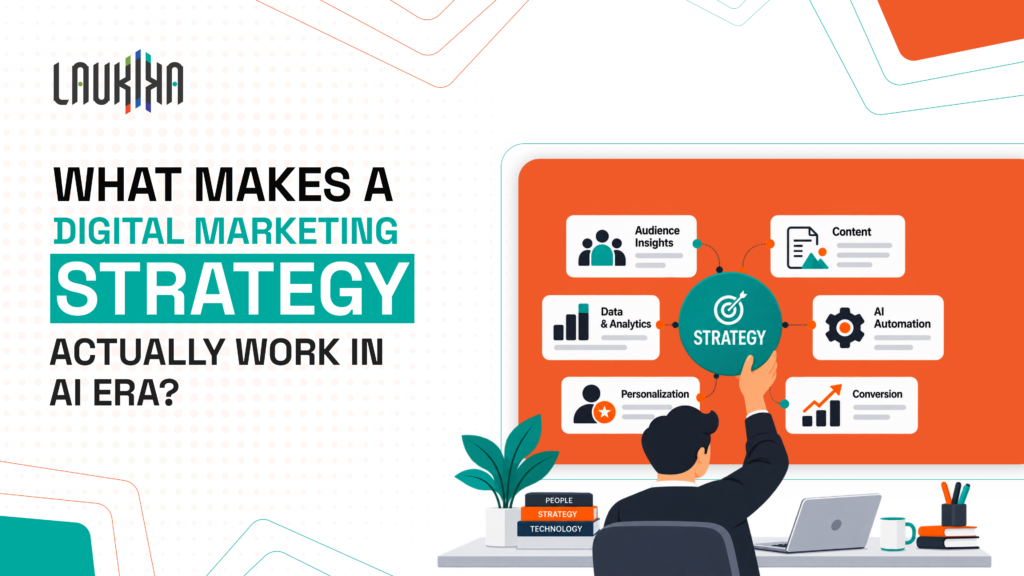
What Is a Digital Marketing Strategy?
A digital marketing strategy is the broader approach a business uses to achieve defined commercial objectives through digital channels. It connects business goals with customer needs, market opportunities, messaging, channels, content, measurement, and optimization.
It is different from simply having a website, running paid advertisements, or maintaining active social media accounts. Those are individual components. The strategy explains how those components work together and why they deserve investment.
Digital Marketing Strategy vs Plan vs Campaign vs Tactics
These terms are often used interchangeably, although they serve different purposes. Strategy establishes direction and commercial priorities. A plan translates that direction into activities, timelines, budgets, and responsibilities. A campaign is a focused marketing initiative built around a particular objective, audience or offer. Tactics are the specific actions used to execute it, such as publishing an article, launching a search campaign, or sending an email.
Confusing these levels can lead to a busy marketing operation without a coherent direction.
Why a Digital Marketing Strategy Matters
Without a clear strategy, teams can spend considerable time producing content, buying media, and reporting numbers without knowing whether those activities are moving the business forward. A strategy creates a basis for deciding what deserves attention, what should be tested, and what should be stopped.
It also creates alignment between marketing and wider business. When objectives are connected to leads, revenue, customer value, or retention, marketing becomes easier to evaluate beyond surface-level engagement.
What a Strong Digital Marketing Strategy Should Achieve
The role of strategy has expanded from generating traffic and engagement to influencing the complete customer relationship. A strong approach should attract relevant audiences, help them understand the value of the offering, support conversion, reduce acquisition inefficiencies, and contribute to retention.
The strongest strategies do not treat these outcomes as separate activities. They connect them into one measurable customer journey.
Why Traditional Digital Marketing Strategies Are No Longer Enough
Many digital marketing strategies were designed around a relatively simple path: attract visitors, generate engagement, capture leads and move prospects toward a purchase. That model still exists, but the journey surrounding it has become considerably less predictable.
Customers Move Across Multiple Digital Touchpoints
A prospective customer may first encounter a company through a social post, search for the brand several days later, read independent reviews, visit the website from a mobile device, and return through a paid advertisement before contacting sales.
Each interaction can influence the next one. A strategy that evaluates every channel independently may miss how those interactions work together.
This is why an effective digital marketing strategy needs a customer-level view rather than a collection of disconnected channel plans. The important question is not simply where a conversion happened. It is what helped the customer become ready to convert.
AI Is Changing How People Discover Information
Search behaviour is moving beyond the traditional results page. People increasingly expect direct answers, comparisons, summaries, and recommendations instead of always working through a list of links. AI-powered search and conversational interfaces are becoming part of that discovery process, often helping users form an opinion before they ever visit a company’s website.
This is changing what organic visibility means. Ranking a keyword is no longer the only consideration; brands also need their information to be clear, useful, credible, and structured enough to be surfaced or referenced across AI-led discovery experiences. Content that simply repeats commonly available information may struggle to stand out, even when it targets relevant search terms.
For marketers, this makes content quality and topical authority more important. Original insights, first-hand expertise, useful explanations, and well-supported information can improve a brand’s chances of remaining discoverable as search behaviour evolves. Organic search is therefore becoming less about capturing a click at a single point and more about building visibility across the wider information journey.
More Channels Do Not Mean Better Strategy
Adding another platform rarely fixes a strategic problem. A company can be active across search, social media, email, video and paid advertising while still failing to reach the right audience with a convincing message.
Channel expansion should follow an identified opportunity. If a platform cannot contribute meaningfully to the customer journey or business objective, activity on that platform can become an expensive distraction.
Activity-Based Marketing vs Outcome-Based Marketing
Activity-based marketing asks whether campaigns were launched, posts were published, and traffic was generated. Outcome-based marketing asks whether those activities produced qualified demand, revenue, customer retention, or another meaningful business result.
The difference is significant. A team can have an impressive volume of marketing activity and still have a weak commercial outcome.
A modern strategy needs to connect execution with measurable business movement. That means choosing activities because they have a clear role in the customer journey, not simply because competitors are doing them or because a particular channel is currently popular.
What Makes a Digital Marketing Strategy Actually Work?
There is no universal channel mix that guarantees marketing performance. What works depends on the business model, audience, market conditions, sales cycle, competitive environment, and resources available to the team. The key is to build each decision around a defined business outcome rather than a preferred channel.
For example, a B2B company trying to increase qualified leads may find that a smaller investment in high-intent search and industry-specific content generates better opportunities than spreading the same budget across several social platforms simply to increase reach. The right choice comes from understanding where potential customers are looking for solutions and which touchpoints influence their decision.
Successful strategies tend to share this same discipline: every major activity has a clear purpose, a defined audience, and a measurable connection to the wider business objective.
Start With Clear Business Objectives
Marketing decisions become easier when the business objective is specific. Increasing awareness, generating enterprise leads, improving ecommerce revenue, and reducing customer churn require different approaches.
The objective should be measurable enough to influence priorities. If the business needs a more qualified pipeline, for example, the strategy should not be judged primarily by impressions or follower growth. Those numbers may have a supporting role, but pipeline quality becomes a more meaningful measure.
A clear objective also helps prevent teams from pursuing attractive but irrelevant opportunities.
Understand the Right Audience and Their Intent
Knowing demographic characteristics is only the starting point. Strategy needs to understand what potential customers are trying to solve, what information they need, what objections slow their decision, and what triggers them to act.
Intent matters because two people searching for similar terms may be at very different stages. One may be exploring a problem, another comparing solutions, and another actively evaluating suppliers.
Audience research should therefore combine customer conversations, search behaviour, website data, sales feedback, competitive information, and other reliable signals. The objective is to understand the decision process, not simply create an audience profile.
Build a Clear Value Proposition
Good targeting cannot compensate for an unclear reason to choose the brand. The value proposition should make it obvious who the offering is for, what problem it addresses, and why the customer should consider it over available alternatives.
This message should remain recognizable across the website, advertising, content, sales material, and social communication. It does not have to be repeated word for word, but the underlying promise should remain consistent.
Select Channels Based on Business Goals
Different channels perform different jobs. Search can capture existing demand. Social media can create attention and community. Email can support nurturing and retention. Paid media can accelerate reach. Content can answer questions and build authority.
The right mix depends on where the audience spends time, how they research the category, and how the company converts demand.
Choosing channels because they are fashionable often creates unnecessary complexity. Choosing them because they solve a defined marketing problem produces a more manageable and accountable system.
Build a Connected Customer Journey
Customers rarely move neatly from awareness to purchase in one sequence. A person may need educational content before accepting a sales conversation, while another may need pricing information immediately.
A useful strategy maps the important stages without forcing every customer into the same path. Content, landing pages, advertising, email, and sales communication should each have a clear role in moving the customer forward.
The experience should also feel connected. A customer who clicks an advertisement promising one thing should not arrive at a page communicating something completely different.
Measure What Actually Matters
Measurements should connect marketing activities with commercial outcomes. Depending on the business, that could include qualified leads, conversion rate, customer acquisition cost, pipeline contribution, revenue, repeat purchases or retention.
This does not mean ignoring channel-level metrics. Click-through rates, engagement, and organic visibility can reveal useful problems and opportunities. They simply should not become the final definition of success.
A reliable strategy creates a feedback loop: objectives determine measurement, measurement reveals what is working, and those findings influence the next round of investment.
How AI Is Changing Digital Marketing Strategy
AI is changing how customers discover and evaluate brands. Instead of relying solely on short keyword searches and browsing individual websites, people can ask conversational questions, compare alternatives, and seek recommendations through AI-powered search experiences.
These tools can summarize information from multiple sources and help users narrow their choices before visiting a brand website. As a result, a company may influence a customer’s decision without receiving a traditional organic click, making website traffic alone an incomplete measure of search visibility.
For marketers, this means understanding which questions their audiences ask, what information influences their decisions, and whether their brand is accurately represented in AI-generated answers. Creating useful, credible content supported by genuine expertise can help brands remain discoverable as search behaviour evolves.
AI Is Changing How Customers Search
People can now ask conversational systems to explain a category, compare products, summarize information, or recommend an approach. The discovery journey can therefore begin with a question rather than a conventional keyword search.
For brands, this increases the importance of clear expertise and useful information. Content needs to answer real questions, demonstrate credibility, and provide enough context to be valuable beyond a single search query.
AI Is Changing Content Production
AI can accelerate research, ideation, outlining, editing, and content adaptation. It can help teams work through large volumes of information faster and create variations for different formats.
Speed, however, does not automatically create quality. If every brand uses similar prompts and produces similar generic language, volume becomes less valuable.
Human involvement remains essential for original thinking, subject expertise, fact checking, tone, positioning, and editorial judgment. AI should make strong teams more capable than turning marketing into automated publishing.
AI Is Changing Audience Intelligence
Large datasets can be difficult to interpret manually. AI can help identify patterns in customer behaviour, segment audiences, summarize feedback and surface relationships that deserve closer examination.
The value lies in turning those patterns into better decisions. A model may identify that a particular audience behaves differently, but marketers still need to determine why that matters and what action is commercially appropriate.
AI Is Changing Paid Marketing
Advertising platforms increasingly use machine learning to manage bidding, targeting, creative combinations, and optimization. This allows campaigns to process more signals than a marketer could realistically evaluate manually.
The marketer’s role therefore shifts toward setting the right objective, supplying strong inputs, defining constraints, and evaluating business outcomes. Automation can improve execution, but poor strategy can still produce poor results faster.
AI Is Changing Customer Experience
AI can support recommendations, conversational assistance, personalization, and faster responses to customer questions. Used thoughtfully, these capabilities can remove friction from the journey.
The strongest implementations still have boundaries. Customers need accurate information, appropriate escalation paths, and a consistent brand experience. Automation should improve the interaction rather than make it feel impersonal or difficult to navigate.
What Is an AI Digital Marketing Strategy?
An AI digital marketing strategy is not simply a conventional marketing plan, with several AI tools added to the workflow. It is an approach in which artificial intelligence is deliberately used where it can improve research, decision-making, execution, personalization, or optimization. The important distinction is that AI supports a defined marketing objective rather than becoming the objective itself.
For example, an ecommerce brand may notice that customers who view a particular product category often leave without purchasing. Instead of manually reviewing thousands of customer interactions, the marketing team can use AI to identify behavioural patterns across browsing history, search queries, previous purchases, and campaign responses. The team can then use those insights to create more relevant audience segments and develop different messages for each group. AI can assist with generating creative variations and predicting which combinations may perform better, while the marketing team reviews the messaging, launches controlled tests, and decides which results justify further investment.
The workflow is therefore practical and measurable: business problem → customer data → AI-assisted insight → marketing action → human review → performance measurement → optimization.
The technology is valuable because it helps the team process information and execute it faster. The strategy still comes from understanding the customer, defining the commercial objective, deciding what should be tested, and judging whether the result actually improves performance.
AI Strategy Is More Than Adding AI Tools
A company can use generative AI for blog drafts, an AI-enabled advertising platform for campaign optimization, and an analytics tool for customer segmentation without having an AI strategy.
A strategic approach begins with a business problem. If research takes too long, AI may help process information. If customer data contains useful patterns that are difficult to identify manually, AI may assist with analysis. If teams struggle to personalize communication at scale, automation may provide a practical solution.
The starting point is the opportunity, not the software.
Where AI Fits into the Marketing Strategy
AI can support several layers of marketing. It can help analyze customer behaviour, identify content opportunities, summarize research, generate creative variations, assist campaign optimization, and personalize experiences.
A useful operating model is:
Business objective → Customer data → Intelligence → AI-assisted execution → Measurement → Optimization
Each stage still requires oversight. The quality of the output depends heavily on the quality of the information, the clarity of the objective, and the judgment applied to the result.
Where Human Expertise Still Matters
Strategy involves choices that cannot be delegated simply because a tool can generate an answer. Positioning, brand direction, ethical boundaries, market interpretation, creative judgment, and commercial prioritization require context.
Human expertise also provides quality control. AI-generated information can contain inaccuracies, generic assumptions, or unsuitable recommendations. A responsible team reviews outputs before they influence customers or business decisions.
The strongest AI marketing approach is therefore collaborative. Machines handle scale and pattern recognition where they are useful; people provide context, judgment, and accountability.
Building a Digital Marketing Strategy Framework for the AI Era
A digital marketing strategy framework gives teams a repeatable way to move from business objectives to execution and measurement. It prevents individual channels or technologies from dictating the strategy.
Step 1: Define the Business Objective
Start by identifying the commercial result marketing needs to influence. Decide whether the priority is qualified demand, revenue growth, market entry, customer retention, or product adoption, then attach a measurable target to it.
For example, if the priority is qualified demand, define the number and quality of leads required rather than simply aiming to increase website traffic. This gives every later marketing decision a clear benchmark.
Step 2: Identify the Target Audience
Define the audience around the problem they need to solve, their motivations, decision criteria, and barriers to purchase. Use customer data, sales conversations, research, and existing behavioural signals to validate these assumptions.
The outcome should be a focused audience definition that tells the marketing team who to prioritize, what matters to them, and what could move them toward action.
Step 3: Map the Customer Journey
Map how the target audience discovers a need, research possible solutions, evaluates alternatives, decides, and interact with the brand after purchase.
At each stage, identify the information or reassurance the customer needs and the action marketing want them to take. This reveals gaps in the journey, such as weak consideration content, unclear conversion paths, or poor post-purchase communication.
Step 4: Identify Search and Demand Opportunities
Research the questions, problems, and commercial topics that influence customer decisions. Look beyond search volume and identify intent, competitive gaps, emerging questions, and areas where existing content fails to provide a useful answer.
The result should be a prioritized set of opportunities that can guide search engine optimization, content, paid search, and other demand-generation activities instead of producing content simply because a keyword has search volume.
Step 5: Choose the Right Marketing Channels
Select channels based on where the target audience seeks information and where each channel can contribute to the business objective. Give every chosen channel a specific role in the customer journey.
For example, search may capture existing demand while social media builds awareness, and email supports consideration or retention. This creates a connected channel mix instead of separate activities competing for attention and budget.
Step 6: Define Content and Messaging
Identify what customers need to understand before they can take the desired action. Build content around those information needs while reinforcing the brand’s value proposition and addressing common objections.
Then adapt the core message across articles, advertisements, videos, email, and social content without losing its central meaning. The outcome should be a content system that supports specific stages of the customer journey rather than a calendar built around publishing frequency.
Step 7: Integrate AI Where It Creates Advantage
Review the strategy for tasks where AI can improve speed, analysis, personalization, or execution. Prioritize areas such as research synthesis, audience analysis, content adaptation, campaign optimization, or customer support where there is a clear efficiency or performance opportunity.
Before implementing a tool, define what improvement is expected. If AI is introduced to accelerate content production, for example, measure whether it actually reduces production time without lowering accuracy, originality, or quality.
Step 8: Establish KPIs and Measurement
Define the metrics that will determine whether each major initiative is contributing to the business objective. Connect to channel-level indicators with outcomes such as qualified leads, conversion rate, acquisition cost, revenue, or retention.
Set these measurement rules before execution begins. This makes it easier to identify underperforming activities, justify investment in successful ones, and distinguish meaningful progress from surface-level engagement.
Step 9: Test, Learn and Optimize
Identify the decisions where uncertainty could materially affect performance, then test them deliberately. This could involve different messages, creative approaches, landing pages, audiences, offers, or channel investments.
Set a clear success measure before each test begins. Use the results to decide what should be scaled, revised, or discontinued. Over time, this turns the strategy into a learning system that improves resource allocation rather than a fixed plan that simply continues running.
Digital Marketing Strategy Best Practices That Drive Results
Effective marketing is not about collecting as many tactics as possible. It is about making better decisions about where to focus, whom to reach, what to communicate, and how to measure the result. The most useful digital marketing strategy best practices are the ones that help teams connect those decisions to clear business outcomes.
A practical approach starts with the customer and works backwards from the desired result. It gives each channel a defined role, uses data to guide investment, creates content with a clear purpose, and treats AI as a capability that can strengthen execution rather than replace strategic judgment.
Align Marketing with Business Goals
Marketing priorities should be traceable to a commercial objective. If the company needs profitable growth, for example, campaign decisions should consider lead quality and customer economics rather than engagement alone.
Prioritize Customer Intent Over Channel Trends
A platform can be popular without being important to a particular customer journey. Understanding what customers want to accomplish should come before deciding where to reach them.
Build First Party Data and Strong Measurement
Reliable customer and performance data give businesses more control over decision-making. Clean analytics, meaningful conversion tracking and appropriate data governance are increasingly valuable as platforms and privacy expectations evolve.
Create Original, Useful Content
Content should contribute something beyond information that can be found everywhere else. Original analysis, experience, expertise, evidence and useful interpretation make content more valuable to both customers and search systems.
Integrate SEO, Content, Paid Media and Social
These disciplines often work better when planned together. Search insights can inform content. Content can support paid campaigns. Social distribution can create additional reach. Paid data can reveal messages that deserve broader development.
Use AI to Augment Teams, Not Replace Strategy
AI is most useful when it removes repetitive work or expands analytical capacity. Strategic direction, editorial judgment, and quality control should remain accountable to people.
Continuously Test and Optimize
Performance changes as audiences, competitors, platforms, and market conditions change. Regular review prevents a strategy from becoming a fixed document that no longer reflects reality.
How Data and Competitive Intelligence Improve Marketing Decisions
A data driven digital marketing strategy depends on more than collecting large quantities of information. The useful question is whether the available data helps the team make a better decision.
What Data Should a Marketing Strategy Use?
Relevant inputs can include website behaviour, search data, CRM information, advertising performance, customer feedback, sales outcomes, conversion data, and retention patterns. The appropriate mix depends on the business model.
Data should be connected wherever possible. If advertising reports strong lead volume while sales reports poor lead quality, those two signals need to be viewed together.
Turning Data into Marketing Decisions
Data becomes useful when it changes an action. If a landing page attracts substantial traffic but produces few qualified enquiries, the response might involve changing the message, offer, audience, or user experience.
Similarly, if one audience segment produces fewer leads but significantly higher revenue, budget allocation may need to reflect that difference.
Avoiding Vanity Metrics
Impressions, followers, and raw traffic can provide context, but they do not necessarily indicate commercial progress. A large audience has limited value if it does not contain potential customers or influences meaningful behaviour.
Metrics should therefore be interpreted according to their relationship with the business objective.
What Competitive Intelligence Should Reveal
Competitive intelligence should examine more than competitor advertising. It can reveal how competitors position themselves, which topics they own in search, what customers praise or criticize in reviews, which they emphasize, and where gaps may exist.
The purpose is not to copy competitors. It is to understand the market well enough to identify where a stronger proposition or better customer experience can create an advantage.
How to Implement a Digital Marketing Strategy
Digital marketing strategy implementation is where strategic decisions become coordinated execution. The priority is not simply to create a list of activities, but to establish what needs to happen, who owns it, what it depends on, and how progress will be judged. This creates a clear path from strategy to delivery and reduces delays caused by unclear responsibilities or disconnected teams.
Prioritize Initiatives
Not every opportunity deserves immediate investment. Rank initiatives according to potential business impact, audience relevance, effort, cost, and confidence in the underlying evidence.
For each priority, assign a clear owner and define the expected outcome. A campaign might be owned by the performance marketing lead, while its landing page sits with the web team and supporting content sits with SEO or content. Making ownership explicit prevents important tasks from becoming shared responsibilities with no accountable person.
Build a Channel and Content Roadmap
Create a roadmap showing which channels, campaigns, content assets, landing pages, and customer experiences will be developed and when. Each activity should have an owner, deadline, expected output, and dependency where relevant.
Dependencies need to be mapped before execution begins. A paid campaign may depend on a completed landing page, approved creative, conversion tracking, and audience setup. Similarly, an SEO content initiative may depend on keyword research, subject-matter input, technical changes, or design support.
Mapping these dependencies early helps teams identify bottlenecks before they affect launch dates.
Establish Reporting and Accountability
Every major initiative should have one clearly accountable owner, even when several teams contribute to delivery. Define the objective, success metric, reporting cadence, and decision-maker before work begins.
Reporting should answer three practical questions: What happened? Why did it happen? What needs to happen next? This turns performance reporting into an operating process rather than a monthly presentation of numbers.
Test Before Scaling
New campaigns, messages, audiences, and channel approaches should be tested against predefined success criteria before significant resources are committed. The team should agree in advance on what result would justify scaling, revising, or stopping the initiative.
This prevents decisions from being driven by assumptions or short-term reactions. A successful test can move into the roadmap as a larger initiative, while a weak result should trigger a review of the audience, offer, message, or execution.
Optimize Based on Performance Data
Implementation should create a continuous feedback loop between execution and decision-making. Review performance against the original objective, identify where results differ from expectations, and determine whether the issue lies with targeting, messaging, creative, conversion experience, channel selection, or another dependency.
When performance improves, document what contributed to the result before scaling it. When it falls short, assign an owner to the corrective action and establish when it will be reviewed again. This turns optimization into an accountable process rather than an open-ended instruction to “improve performance.”
How to Measure Whether Your Digital Marketing Strategy Is Working
Measurement should reflect the stage of the customer journey and the commercial objective. A digital marketing strategy cannot be judged properly through one universal metric.
Awareness Metrics
Reach, relevant impressions, branded search activity, organic visibility, and qualified website traffic can help assess whether the brand is becoming discoverable among the right audience.
Acquisition Metrics
Acquisition measurement should examine the quality and cost of incoming demand. Qualified leads, conversion rates, cost per qualified lead, and customer acquisition cost provide stronger insight than traffic volume alone.
Conversion Metrics
Conversion metrics connect marketing activity to business action. Depending on the business, these may include an enquiry-to-opportunity rate, sales conversion, purchase value, pipeline contribution, and revenue generated.
Retention Metrics
For businesses with repeat purchases or ongoing relationships, retention is essential. Repeat purchase rate, churn, renewal, customer lifetime value and expansion revenue can reveal whether marketing is creating durable customer value.
AI-Era Visibility Metrics
AI-led discovery creates visibility signals that traditional SEO reporting may not fully capture. Brands should monitor how often they appear in AI-generated answers, whether their brand or products are accurately represented, which sources are being referenced, what queries trigger those mentions, and whether competitors are appearing instead.
It is also useful to track changes in branded search behaviour, referral traffic from AI-powered interfaces where measurable, and engagement or conversions that follow AI-assisted discovery. Monitoring these signals over time can reveal whether the brand is becoming more visible in emerging discovery journeys, even when that visibility does not result in a conventional organic click.
These metrics should complement established measures such as qualified traffic, leads, conversion rate, acquisition cost, revenue, and retention. The purpose is not to replace traditional performance measurement, but to understand where and how customers are discovering the brand as search behaviour evolves.
Digital Marketing Strategy vs AI Marketing Strategy
An AI marketing strategy should not be treated as a replacement for a broader digital marketing strategy. The two describe different levels of thinking. Digital strategy defines the commercial direction and customer journey, while an AI-focused approach determines where artificial intelligence can strengthen that system.
| Area | Digital Marketing Strategy | AI Marketing Strategy |
|---|---|---|
| Channel focus | Selects channels according to audience behaviour and business objectives | Uses automation and intelligence to improve channel execution |
| Analysis | Relies on analytics, research and human interpretation | Adds machine-assisted pattern recognition and predictive analysis |
| Personalization | Uses audience segments and behavioural signals | Enables greater personalization at scale |
| Optimization | Uses testing, reporting and manual or platform-based adjustments | Uses AI-assisted prediction, automation and continuous optimization |
| Content planning | Based on audience needs, search intent and business priorities | Uses AI to identify patterns, assist production and adapt content |
| Reporting | Measures performance against defined KPIs | Accelerates analysis and can surface anomalies or opportunities |
| Human/AI collaboration | Human-led strategy and execution | Human-led judgment supported by AI capabilities |
The distinction is important because AI does not determine what a business should achieve, which customers it should prioritize, or how it should position itself in the market. Those decisions belong to the broader digital marketing strategy. AI can support the process by analyzing information faster, identifying patterns, personalizing communication, and improving execution at scale.
An AI marketing strategy therefore works within the wider digital marketing strategy rather than replacing it. The broader strategy establishes the objectives, audience, positioning, and measures of success; the AI approach identifies where intelligent automation and analysis can help achieve those goals more effectively. When the two are aligned, AI strengthens marketing decisions and execution without taking the place of strategic direction or human judgment.
Common Reasons Digital Marketing Strategies Fail
Even well-funded marketing programs can underperform when strategic decisions are poorly aligned with audience needs and business outcomes. The consequences often appear gradually: wasted budgets, missed opportunities, weak conversions, or declining customer trust.
Focusing on Channels Instead of Outcomes
Being present on every major platform does not automatically create demand. When channel activity becomes the objective, teams can lose sight of the commercial result they are supposed to influence. The result is often a higher marketing spend without a corresponding improvement in qualified leads or revenue.
Trying to Reach Everyone
Broad targeting often produces diluted messaging and inefficient spending. A clearer understanding of the most valuable audience creates stronger communication and better prioritization. Without that focus, campaigns may attract attention from people who are unlikely to convert, increasing acquisition costs.
Creating Content Without Search or Customer Intent
Publishing regularly is not a strategy by itself. Content needs a clear purpose, whether it answers a customer’s question, supports consideration, strengthens authority, or helps conversion. When content misses the audience’s actual needs, it can generate little meaningful engagement or organic traffic despite the resources invested in producing it.
Using AI to Produce More Instead of Producing Better
Large volumes of generic content can weaken differentiation. AI should help teams improve research, relevance, and execution rather than simply increase publishing frequency. If content lacks original insight or contains unchecked inaccuracies, the brand risks losing credibility while adding more material that fails to stand out.
Ignoring Data Quality
Poor tracking, inconsistent definitions, and disconnected systems can lead to confident decisions based on unreliable information. Better analytics cannot compensate for fundamentally poor inputs. This can lead teams to misallocate budgets, misread campaign performance, and scale activities that are not delivering genuine business value.
Measuring Vanity Metrics
High impressions or engagement can look impressive while hiding weak lead quality or poor commercial performance. Metrics need to connect to the outcome that matters. When teams optimize for visibility alone, they may overlook declining conversion rates or rising customer acquisition costs until those problems affect business performance.
Failing to Connect Marketing and Sales
Marketing and sales often see different parts of the customer journey. Without shared definitions and feedback, marketing may optimize for leads that sales cannot use effectively. This creates wasted follow-up effort, slows the sales process, and makes it harder to determine which marketing activities generate revenue.
Not Updating the Strategy
Markets, competitors, customer expectations, and technology change over time. A strategy that worked twelve months ago may require significant adjustment today. Without regular reviews, businesses can continue investing in declining channels, miss emerging demand, and lose ground to competitors who respond more quickly.
FAQs About Digital Marketing Strategy
What Is a Digital Marketing Strategy?
A digital marketing strategy is a structured approach to using digital channels, content, data, and customer insights to achieve defined business objectives. It connects audience needs and marketing activities with measurable outcomes such as qualified leads, revenue, customer acquisition, or retention.
What Makes a Digital Marketing Strategy Effective?
An effective strategy begins with clear business objectives, a well-defined audience, and a strong value proposition. It selects channels according to customer behaviour, connects the customer journey and measures performance against meaningful commercial outcomes rather than relying primarily on engagement metrics.
How Is AI Changing Digital Marketing Strategy?
AI is changing how customers discover information and how marketers conduct research, analyze audiences, produce content, personalize experiences, and optimize campaigns. It increases the speed and scale of execution, while human expertise remains important for strategy, originality, judgment, accuracy, and quality control.
What Is an AI Digital Marketing Strategy?
An AI digital marketing strategy deliberately incorporates artificial intelligence into areas where it can improve marketing performance. This may include audience analysis, content workflows, personalization, campaign optimization, or customer experience. The strategy remains business-led, with AI supporting specific decisions and processes.
What Are the Key Components of a Digital Marketing Strategy?
The key components include business objectives, audience understanding, value proposition, customer journey, search and demand opportunities, channel selection, content and messaging, measurement and optimization. Strong strategies also establish how marketing activities connect with sales, customer experience, and wider business priorities.
What Is a Digital Marketing Strategy Framework?
A digital marketing strategy framework is a structured process for turning business goals into marketing decisions and measurable execution. It typically covers objectives, audience research, customer journey mapping, demand opportunities, channel selection, messaging, AI integration, KPIs, and continuous optimization.
How Do You Measure the Success of a Digital Marketing Strategy?
Success should be measured against the original business objective. Depending on the organization, useful indicators may include qualified leads, conversion rate, customer acquisition cost, pipeline contribution, revenue, repeat purchases, retention and customer lifetime value. Channel metrics provide supporting context rather than the final verdict.
How Can Businesses Implement AI in Digital Marketing?
Businesses should first identify marketing processes where AI can solve a genuine problem, such as slow research, complex data analysis, repetitive content adaptation, or campaign optimization. They can then introduce suitable tools, establish human reviews, and measure whether the implementation improves efficiency, quality, or commercial performance.
Conclusion: What Makes a Digital Marketing Strategy Work in the AI Era?
A digital marketing strategy works when it connects what the business needs with what customers actually need to know, understand, and do. The channels may change, search behaviour may evolve, and AI may introduce entirely new ways of discovering information, but the strategic foundation remains clear.
Businesses need defined objectives, a precise understanding of their audiences, relevant messaging, connected customer journeys, and measurement that reaches beyond surface-level activity. AI can make many parts of that system faster and more intelligent, but it cannot replace the judgment required to decide where the business should compete, what it should stand for, or what customers genuinely value.
The most effective approach is therefore neither traditional marketing with a few AI tools added, nor an AI-first strategy detached from commercial reality. It is a digital marketing strategy built around outcomes, strengthened by data, and supported by technology where technology creates a genuine advantage.
That is what allows marketing to remain useful, measurable, and adaptable as the digital environment continues to change.
Recent Blogs
What Makes a Digital Marketing Strategy Actually Work in AI Era
The way customers discover, evaluate, and choose brands has changed, and marketing strategies have had to change with it.Customers now
What Is Google Search AI and What It Means for Your Website
Learning to speak English is rarely about knowing one more grammar rule. The real challenge is having enough confidence to