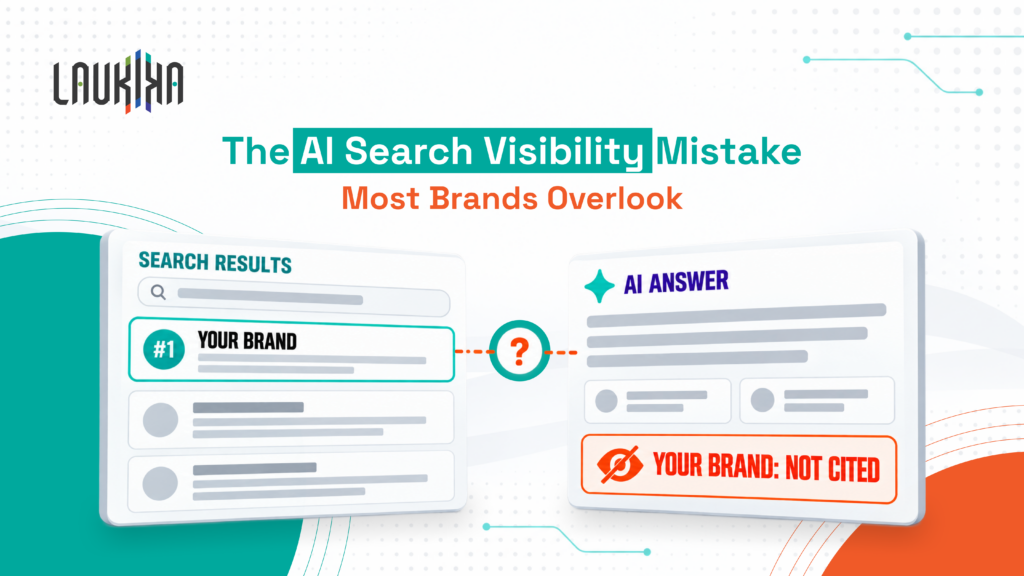
The mistake is assuming Google rankings tell the whole story
A strong SEO report provides useful information about keyword positions, organic traffic, impressions and click-through rates. However, these metrics do not establish how frequently your business appears in AI-generated answers. Someone searching for a broad product category has different information needs from someone asking an AI assistant to recommend a solution for a specific business problem.
Ranking for a keyword does not guarantee that your website will appear in an answer to a detailed buyer question. The response may cite other sources, recommend competing businesses or omit your brand entirely. This does not make SEO less important. Relevant content, technical accessibility and a well-structured website remain valuable. The mistake is assuming visibility without checking it.
For example: A company ranks well for a broad software category but does not appear when buyers ask which tools suit a small healthcare team with a limited budget. Its traditional search performance is strong, but its visibility for that particular buying decision remains uncertain.
What AI search visibility actually means
AI search visibility describes how often and how accurately a brand appears in AI-powered search experiences and assistant responses. Rather than focusing on one ranking position, it considers whether potential customers encounter your business while researching problems, evaluating options or comparing solutions. Understanding brand visibility in AI search means looking beyond mentions alone and examining the context in which your business appears.
- Brand mentions: The answer names your business, product or service.
- Website citations: The answer links to a page on your website as a supporting source.
- Recommendations: Your business appears among the options suggested to the user.
- Description accuracy: The answer correctly represents your offering, capabilities and limitations.
These outcomes are different. A website can be cited without its business being recommended, while a brand can be mentioned without receiving a direct website link.
Generative engine optimization (GEO) and Answer engine optimization (AEO) are overlapping approaches to improving discoverability and the usefulness of information in answer-oriented experiences. Both complement traditional SEO. Their terminology varies across the industry, but the practical objective is to make relevant, accurate information easier to discover and understand.
Why a well ranked website may still be missing from AI answers
Buyer questions contain context that broad keywords miss
Customers often add details about their industry, location, budget, compatibility requirements or intended use. A page that explains a product category may not answer these specific questions sufficiently.
Consider these contrasting queries:
- Broad search: Best customer relationship management software.
- Detailed question: Which customer relationship management software suits a 10-person real estate agency with a limited monthly budget?
The second question requires information about pricing, team size and industry-specific features. If your page covers general benefits but overlooks these requirements, it may not provide enough information to support the buyer’s decision. Reviewing actual customer questions can reveal where your existing content needs greater depth.
Different platforms can surface different sources
AI search experiences do not all retrieve and present information in the same way. One platform may use web search to support its response, while another may use a different retrieval process. Results from one platform should not be treated as representative of every AI search experience.
Answers can also vary with platform, search mode, prompt wording and follow-up context. Date and repeated testing matter, too. A response that appears today may differ when the same question is asked again. Testing across relevant platforms and repeating selected prompts helps distinguish recurring patterns from isolated results.
Your content may leave important questions unanswered
When researching AI search ranking factors, remember that there is no single publicly confirmed formula explaining source selection across all AI platforms. Instead, assess whether your content answers the questions customers genuinely ask and provides enough information to support their decisions.
Look for missing elements such as:
- Clear explanations of suitability, use cases and limitations.
- Evidence supporting important product or service claims.
- Accurate specifications and details that make comparisons useful.
These gaps deserve attention because they affect how well your content serves readers. Improving the quality and completeness of your information is a more practical starting point than trying to reverse-engineer an unverified ranking formula.
How to check whether your brand has an AI visibility gap
Before making changes, establish a repeatable baseline. A straightforward SEO audit can reveal where your brand appears, where competitors feature instead and which customer questions expose the most significant gaps. Record your observations so future tests can be compared against the same starting point.
Rather than relying only on a conventional results page, AI Mode can bring together information from multiple parts of the web and help users explore a topic in greater depth. This makes it particularly useful for searches involving comparisons, planning, research or questions that develop as the user learns more.
Google has continued expanding AI Mode as part of its broader AI Search strategy. In 2026, Google said AI Mode had surpassed one billion monthly users globally and that queries had more than doubled each quarter since launch.
For website owners, this creates another opportunity for content to be discovered through Search. A page may be surfaced as a relevant source within these newer experiences, making useful, authoritative and well-structured content increasingly important for visibility.
Build a list of real customer questions
Start with questions customers ask before choosing a product or service. Use existing business information to make your test set relevant.
- Sales conversations, customer enquiries and support questions.
- Existing search query data from SEO tools.
- Product comparisons and common buying objections.
Include branded and unbranded questions. Testing only your business name shows whether a platform recognises your brand, but not whether unfamiliar customers discover it when researching their needs. Unbranded questions are particularly useful for evaluating discovery opportunities.
Test a consistent set of questions
Choose representative questions and test them across platforms and search modes relevant to your audience. Record the conditions so that later observations can be compared fairly.
For every test, capture:
- Platform and search mode.
- Exact prompt and relevant follow-up context.
- Test date.
- Relevant location or session conditions.
Repeat selected tests to observe variation. Keep the core question set stable while adding new questions when customer needs or business offerings change. Consistency makes the findings more useful without assuming that every response should remain identical.
Record mentions, citations and recommendations separately
Use a spreadsheet to document each outcome instead of treating every appearance as the same type of visibility.
- Brand appearance: Was your business named?
- Website citation: Was a page on your website linked?
- Recommendation: Was your business suggested as an option?
- Description accuracy: Was your offering represented correctly?
- Competitor presence: Which competing businesses appeared?
Mentions indicate recognition, citations show when website content is referenced, and recommendations indicate whether your business enters a particular consideration set. Keeping these measures separate makes the audit more useful for understanding what is working and what needs investigation.
Inspect the pages that receive citations
Open the cited pages and examine the information they provide. Look for comparisons, specifications, research, reviews or practical explanations that your own content may lack.
For example: A buyer asks an AI platform, “Which project management tool is suitable for a small team with a budget of ₹2,000 per month?” The cited competitor page explains plan pricing, team size limits and key features. Your brand’s page describes its features but does not clarify pricing or suitability for small teams. A useful update would be to add clear plan details, relevant limitations and guidance on who the product suits.
How to address the gaps your audit reveals
Check whether important pages can be accessed
Start by confirming that priority pages are technically accessible, indexable and contain information that search systems can interpret. Technical issues may limit discovery, although resolving them does not guarantee that a page will be selected or cited.
For Google AI Overviews and AI Mode, pages must be indexed by Google and eligible to appear with a search snippet to be considered as supporting links. Being indexed does not guarantee that a page will appear in an AI-generated response.
Review these areas:
- Crawl and indexing controls: Check robots.txt rules, page-level directives and unintended indexing restrictions that may prevent Google from accessing or indexing important pages.
- CDN and security settings: Ensure security tools are not unintentionally blocking Googlebot or other relevant crawlers.
- Readable content: Make essential explanations, specifications and product information available as accessible text rather than relying entirely on images or inaccessible elements.
- Internal links: Connect priority pages through relevant website sections so search engines and users can discover them more easily.
- Structured data: Use appropriate schema markup that accurately reflects visible page content. It can help search engines understand a page, but does not guarantee inclusion in AI answers.
There is no need to create special AI schema markup or AI-specific text files to appear in Google AI Overviews or AI Mode. Focus on making useful pages accessible, indexable and eligible for search snippets, while keeping in mind that eligibility does not guarantee visibility in AI-generated answers.
Answer the questions buyers need to make decisions
Review important pages from the perspective of someone deciding whether your offering meets a particular requirement. Explain not just what you provide, but also when it is appropriate. Specific, useful answers can serve potential customers better than broad promotional descriptions.
Explain who the offering is suitable for
Describe your intended audience, common use cases and relevant requirements. Clarify whether the offering suits small teams, large organisations, specific industries or users with particular technical needs.
Make comparisons useful
Explain meaningful differences between options, including features, costs, benefits and trade-offs. Give readers selection criteria rather than unsupported claims that your product is universally superior.
State limitations clearly
Include exclusions, dependencies and conditions that affect suitability. Transparent explanations help customers make informed decisions and prevent misleading impressions.
For example, replace “We provide scalable business software” with “Our software supports small sales teams that need contact management and pipeline tracking. Advanced reporting requires the Professional plan.” The revised description answers a more specific buyer question.
Support important claims with evidence
Clear writing matters, but readers also need evidence to evaluate your claims. Strengthen important pages with relevant information that can be checked and understood in context.
Useful evidence includes:
- Original research with its methodology and limitations explained.
- Case studies with dates, customer context and documented outcomes.
- Expert explanations with named contributors and relevant credentials.
- Product specifications or documented service processes.
Avoid presenting isolated testimonials or unsupported performance figures as universal proof. Evidence helps readers assess whether claims apply to their situation. This gives your content a stronger factual foundation and helps prospective customers evaluate your claims.
Make brand information clear across relevant sources
Your website should describe your business consistently, and relevant external sources should not contradict essential details. Outdated descriptions, conflicting service information or incorrect locations can confuse potential customers.
Review relevant business profiles, partner listings and industry references. Prioritise credible sources that genuinely relate to your business instead of submitting information indiscriminately to directories.
Check that the following details are accurate:
- Business name and category.
- Product and service descriptions.
- Locations and contact information.
- Relevant partner listings and industry profiles.
Keep your website updated whenever important business details change, and correct outdated information on relevant external sources where possible. Consistency supports customer understanding, although it does not independently guarantee AI visibility.
Measure progress without confusing visibility with traffic
Track presence across your saved question set
Use your saved questions to calculate a simple mention rate. Count an answer when it names your brand, applying the same definition throughout your testing.
Mention rate = (Answers mentioning your brand ÷ Total answers tested) × 100
If your brand appears in 12 of 40 tested answers, its mention rate is 30% for that sample. Record website citations separately because mentions do not always include links. These results apply only to the prompts, platforms and conditions tested, not every possible AI interaction.
Review accuracy and competitor presence
Visibility matters more when the information presented is accurate and relevant. Review brand descriptions alongside competitor appearances to identify where further investigation may be useful.
Check whether:
- Brand descriptions reflect your current offering.
- Your business appears for relevant use cases.
- Competitors appear more consistently in the same tests.
Compare results using consistent definitions and testing conditions. One changed response is not necessarily evidence of a meaningful improvement or decline. Look for recurring patterns before deciding which content gaps deserve attention.
Connect visibility with meaningful business outcomes
Where tracking permits, examine identifiable referral visits from AI platforms, enquiries and conversions. Analytics can help establish whether AI-assisted discovery contributes to measurable website activity.
Keep these outcomes separate from mentions and citations. A brand mention does not prove that someone visited your website, submitted an enquiry or purchased a product. Customer feedback about how someone discovered your business can provide useful supporting evidence, but avoid claiming precise attribution when the information is incomplete.
Turn your findings into a practical improvement plan
Fix access and accuracy issues first
Prioritise inaccessible pages, incorrect business information and outdated details that could mislead customers. Resolve these practical issues before investing heavily in new content.
Improve pages linked to important buyer questions
Select a few commercially relevant gaps. Assign each page a specific customer question, the evidence required to answer it and a person responsible for the update. Focus on improvements that support real buying decisions.
Repeat the tests and review what changed
Record publication dates and rerun your saved questions under comparable conditions. Assess trends across repeated observations instead of drawing conclusions from a single response.
Treat the process as an ongoing review. Document findings, prioritise useful improvements and refine your approach as customer needs and AI search experiences evolve. Avoid attributing every change to one edit or promising results within a fixed period.
Frequently Asked Questions
What is AI search visibility?
Does ranking first on Google guarantee AI search visibility?
Why is my brand not showing up in AI search?
How can I get cited by ChatGPT?
What is the difference between SEO, AEO and GEO?
Can a brand be mentioned without its website being cited?
How often should I check AI search visibility?
Do I need special schema to appear in AI answers?
Check whether your brand appears where customers ask questions
Strong search rankings remain valuable, but they do not tell you everything about how customers discover your business through AI-powered experiences. Test relevant customer questions, document visibility gaps and improve accessibility, content quality and brand accuracy. Then repeat your tests and review the results consistently. This ongoing process helps your team make informed decisions about content and technical improvements without relying on assumptions about how every AI platform works.
Ready to strengthen your search strategy?
Find out where your brand appears in AI answers and which gaps deserve attention.
Speak to our team about reviewing your search visibility.
Recent Blogs
Top 15 Mistakes in SEO Friendly Website Design
A website can look professional and still struggle to attract visitors from Google. The problem may not be the content
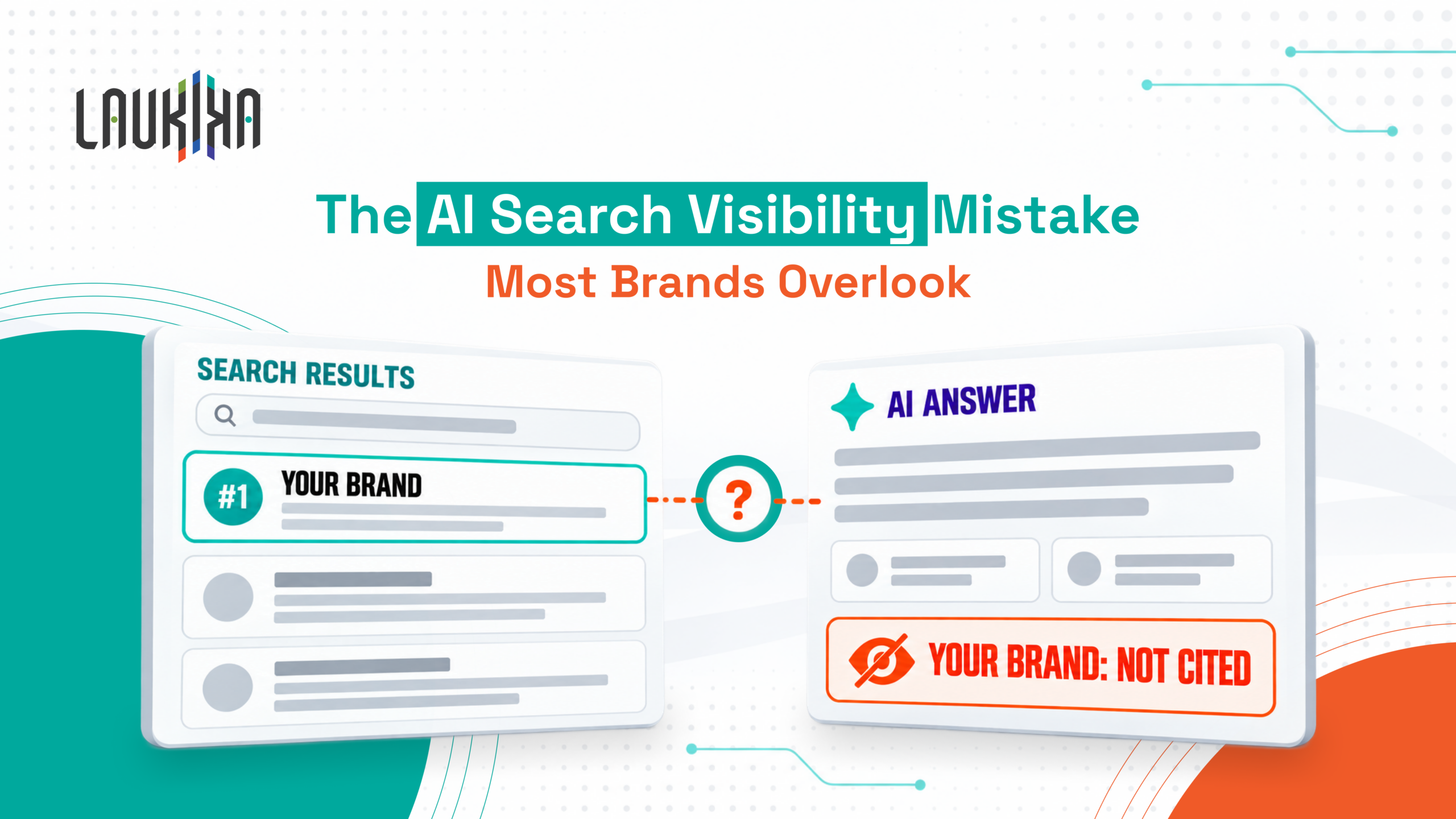
The AI Search Visibility Mistake Most Brands Overlook
A brand can rank well on Google, attract organic traffic and still remain absent when potential customers ask AI platforms