
What Is Programmatic SEO and How It Works in 2026
- August 12, 2026
- Devavratha
- No Responses
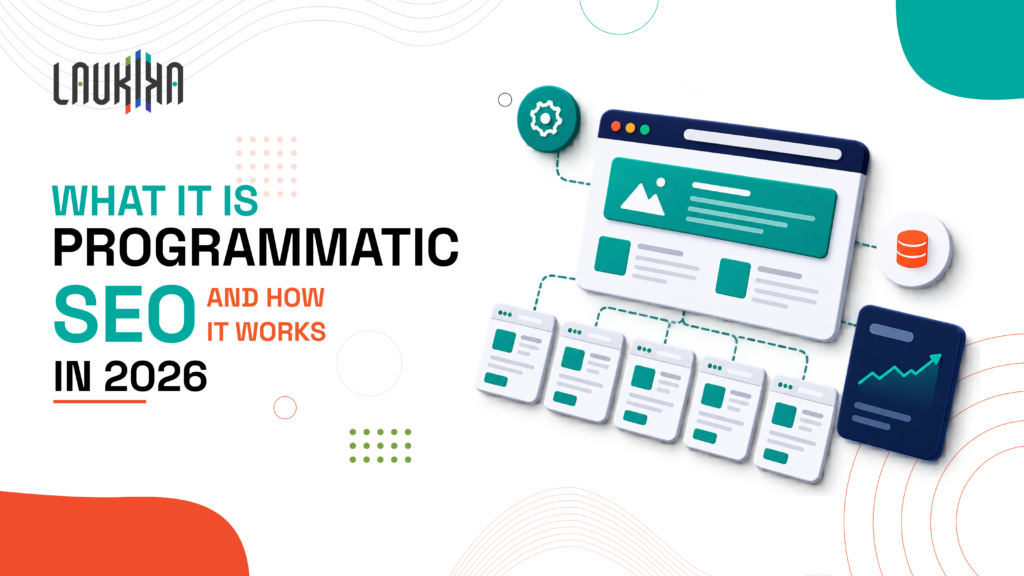
Programmatic SEO is a way to create useful, search-focused pages at scale by combining repeatable templates with structured data. Instead of writing every landing page manually, a business builds a system that can produce hundreds or thousands of relevant pages around predictable search patterns.
The idea is not new. Travel sites have long created destination pages, marketplaces generate category and location pages, and software platforms build integration or comparison pages from databases. What has changed in 2026 is the quality bar. Search engines can understand near-duplicate pages more effectively, while Google’s spam policies explicitly target scaled content created mainly to manipulate rankings. AI-powered search adds another layer: pages now need to be easy to retrieve, understand and cite, not merely optimised around an exact keyword.
Done well, programmatic SEO turns a strong dataset into a search acquisition engine. Done badly, it creates thousands of URLs that users do not need and search engines may choose not to index.
What Is Programmatic SEO and Why Are Smart Brands Betting on It
What is programmatic SEO? It is the systematic creation of search pages using a shared template, a scalable keyword pattern and data that changes meaningfully from one URL to the next. Semrush describes it as automation used to publish large numbers of pages for many search queries, usually with data from APIs, databases or other structured sources. Ahrefs similarly defines it as automatic or near-automatic creation of keyword-targeted pages.
Brands are interested because there may be more valuable search combinations than a content team could write one by one.
- It captures long-tail demand at scale. One head term can expand across locations, products, integrations, use cases, industries or attributes.
- It connects SEO directly to business data. Inventory, pricing, reviews, availability, product specifications and proprietary scores can become useful search experiences.
- It reduces repetitive production work. Teams invest in the template, data pipeline and quality rules instead of rebuilding every page from zero.
- It creates commercially relevant landing pages. Many programmatic patterns sit close to action: “X vs Y,” “service in city,” “product for use case,” or “currency A to currency B.”
- It can compound over time. New records, products or locations can create new pages without a proportional increase in editorial workload.
The catch is important. Google’s current spam policy says mass-produced, unoriginal pages with little user value can qualify as scaled content abuse, regardless of whether humans, AI or automation created them. Scale is useful only when each page earns its place.
Real Programmatic SEO Examples From Brands Generating Millions of Visits
Zapier and 800,000 Integration Pages That Drive 306,000 Monthly Visits
Ahrefs previously estimated roughly 800,632 pages in Zapier’s app directory and about 306,000 monthly organic visits to that programmatic footprint. The logic is straightforward: every app and many app pairings create a distinct search need. A page can show supported triggers, actions and workflows instead of generic copy. The model is even more defensible today because Zapier says its ecosystem covers 9,000+ apps. The database is the content asset; the template simply makes it searchable.
How Wise Built Around 14,900 Currency Pages With 4.6 Million Monthly Visitors
Wise is a classic data-led example. Ahrefs estimated about 14,888 currency-converter pages producing roughly 4.67 million monthly organic visits in its benchmark, not 31,500 pages. Each currency pair can surface a live conversion rate, historical chart, related pairs and a direct conversion tool. Wise currently supports conversion across 140 currencies. That continuing utility is why “USD to INR” is more than a keyword variation: the page performs a task that changes with real market data.
Clutch and the Agency Directory Built Around City-Based Searches
Clutch turns its provider database into category-and-location pages such as digital marketing agencies in India or Bengaluru. Each page can populate agency profiles, service mix, review signals, pricing bands and location relevance from structured records. Location is not decorative. It changes the shortlist a buyer receives. Clutch also updates ranking pages with current review and rating information, giving the template a reason to exist beyond a city-name substitution.
G2 and Software Comparison Pages That Capture Buyers Ready to Decide
G2 applies the model to software discovery. Its comparison pages bring together product scores, feature information, alternatives and data from verified user reviews; G2 currently says it has more than 3.5 million verified reviews. These pages align naturally with high-intent searches such as “Product A vs Product B.” There is also a warning here. Backlinko’s 2026 analysis notes that G2’s estimated organic traffic is far below its 2021 peak, showing that a successful programmatic footprint still has to evolve with competition, search features and user expectations.
Nomadlist and 25,000 City Pages Built on Proprietary Scoring Data
Ahrefs estimated about 25,873 Nomad List location pages in its programmatic SEO study. The reason the format works is not the city name alone. Each location can carry variables such as internet speed, cost, weather, language and other decision-making signals for remote workers. That produces a genuinely different answer for Chiang Mai, Lisbon or Bengaluru. Proprietary scoring also creates a moat: competitors can copy the template quickly, but reproducing a trusted dataset is much harder.
Programmatic SEO vs Traditional SEO: Which Approach Wins for Your Business
Programmatic SEO vs traditional SEO is not a choice between “modern” and “old-fashioned” SEO. They solve different content problems. Traditional SEO is stronger when a topic needs expert interpretation, narrative depth or original argument. Programmatic SEO is stronger when search demand repeats across hundreds of combinations and the business owns or can maintain data that makes each page useful.
Speed and Scale of Content Creation
Traditional pages are researched, written and reviewed individually, giving editors more control but limiting output. A programmatic system front-loads the work: build the dataset, template, logic and QA rules once, then generate many pages from that structure. The initial setup can be demanding, but expansion is much faster once the pipeline works.
Content Depth and Source of Uniqueness
Traditional content usually creates uniqueness through expertise, reporting, examples and editorial judgment. Programmatic pages create uniqueness through data, calculations, inventory, reviews, location variables or product relationships. If only the keyword changes while the substance stays the same, the model has lost its advantage and starts to resemble thin content.
When Each Approach Is the Right Choice
Use traditional SEO for thought leadership, complex guides, research-led explainers and subjects where nuance matters. Use programmatic SEO when the query pattern is repeatable and each variation has a distinct answer. Many strong sites use both: editorial content builds authority, while programmatic pages capture structured long-tail demand.
| Factor | Traditional SEO | Programmatic SEO |
|---|---|---|
| Content creation speed | Slower; pages are produced individually | Fast after the data and template system is built |
| Scale potential | Usually tens or hundreds of pages | Hundreds to millions of possible pages |
| Resource requirement | Writers, editors, SEO and subject experts | SEO, data, engineering/CMS support and QA |
| Best content type | Guides, analysis, research, thought leadership | Directories, comparisons, locations, integrations, catalogues |
| Quality risk level | Usually page-specific | Can become site-wide when templates or data are weak |
| Time to ROI | Gradual; depends on authority and competition | Can scale quickly, but discovery and indexation may be the bottleneck |
| AI search citation rate | No fixed rate; depth and authority can help | No fixed rate; unique structured facts can help when they answer the query directly |
How to Do Programmatic SEO Without Writing Every Page From Scratch
Find a Keyword Pattern That Scales to Hundreds of Variations
Start with a head term that naturally combines with repeatable modifiers. SaaS companies may find “[tool] integrations,” marketplaces may find “[service] in [city],” while ecommerce stores may see “best [product] for [use case].”
Check whether the pattern expands into enough real demand to justify a system rather than a handful of manually written pages.
- Group modifiers by type: location, product, feature, audience or comparison.
- Pull search volume and SERP data for representative samples.
- Remove combinations that sound possible in a spreadsheet but unnatural in search.
- Look for patterns that map to a business action, not only an informational keyword.
The goal is not the biggest keyword list. It is a repeatable search need.
Validate Search Intent Before You Build Anything
A scalable keyword pattern can still fail if every query does not want the same kind of page. Search ten to twenty representative variations manually and compare the results.
If Google shows directories for one set, editorial guides for another and product pages for a third, one template may not satisfy all of them.
- Record dominant page types in the SERP.
- Note recurring information: prices, ratings, maps, specifications, comparisons or calculators.
- Identify what users can do on the top-ranking pages.
- Split mixed-intent keyword groups into separate templates.
This step prevents a common mistake: building hundreds of structurally consistent pages for an inconsistent search intent.
Source the Data That Makes Every Page Different
The dataset is the real engine. Proprietary product information, first-party usage data, verified reviews, live inventory, pricing, scores, API feeds and carefully licensed public datasets can all work.
Ask a harder question before publishing: if the copy template disappeared, would the data on this URL still be worth seeing?
- Prefer first-party or proprietary data where possible.
- Track source, update frequency and ownership for each field.
- Avoid scraping information you cannot legally or reliably maintain.
- Define fallbacks for missing values instead of publishing empty modules.
- Add human interpretation where raw data could be misleading.
A strong data layer makes each page distinct without forcing writers to invent uniqueness.
Build a Structured Database as Your Foundation
Do not store the project as hundreds of disconnected documents. Create a structured source of truth where every row or record represents an entity and every column or field maps to a reusable page element.
A small pilot might live in Google Sheets or Airtable. Larger projects may need a relational database, warehouse or product-information system. If you are new to how structured data signals work for search engines, our guide on what is schema markup covers the foundation.
- Create stable IDs, slugs and canonical URLs.
- Separate raw data from calculated or editorial fields.
- Validate required fields before a record can publish.
- Add timestamps for freshness-sensitive data.
- Keep change history for high-risk values such as price or availability.
Once the schema is stable, page generation becomes predictable instead of fragile.
Design a Page Template That Works at Scale
A scalable template should answer the query quickly while leaving room for information that varies by record. Build modules around user decisions, not around how convenient the database is.
A location page might need a summary, local options, prices, reviews and nearby alternatives. A comparison page may need differences, common use cases, ratings and a clear decision framework.
- Use unique titles and headings generated from validated fields.
- Include modules only when relevant data exists.
- Add crawlable links to parent, sibling and related pages.
- Keep important content in HTML rather than hiding it behind interaction.
- Test mobile rendering, speed and accessibility before rollout.
The best template feels consistent without feeling copied.
Publish, Monitor and Quality Control Every Page
Launch in batches, not as an uncontrolled dump of every possible URL. Index a representative set, watch how search engines crawl and classify it, then expand based on evidence.
Google states that sitemaps help discovery but do not guarantee crawling or indexation. Search Console should therefore be part of the publishing workflow. If you need a full health check of your site before scaling, a professional SEO audit can surface indexation gaps, canonical issues and crawl inefficiencies before they multiply.
- Monitor indexed versus submitted URLs.
- Inspect “Discovered – currently not indexed” and canonicalisation patterns.
- Track impressions, clicks and conversion by page template.
- Remove, merge or noindex pages with no standalone value.
- Re-crawl the site after major template or internal-linking changes.
Programmatic SEO needs an operating system, not a one-time launch.
The Programmatic SEO Strategy That Scales Without Breaking Quality
A programmatic SEO strategy should define where automation is allowed, what makes a page unique and what performance threshold justifies keeping it indexed. In 2026, page count is a weak success metric. A healthier scorecard looks at indexation, qualified traffic, conversions, data freshness and whether each template continues to satisfy the query better than simpler alternatives.
Is Programmatic SEO Right for Your Business
It is a strong fit when search demand repeats predictably and your business has structured information that materially changes the answer. Ecommerce catalogues, marketplaces, SaaS integrations, directories and data products are natural candidates. It also helps when the resulting pages support acquisition, conversion or product discovery directly. If every useful page still requires deep bespoke research, traditional publishing may be more efficient.
Mapping Your Head Term and Modifier Framework
Write the keyword model as a formula before building pages: [service] + [location], [product] + [attribute], [tool A] + [tool B], or [currency A] + [currency B]. Then define which combinations are valid. Use keyword research to confirm which modifier combinations show consistent intent before opening them to indexation. A database should generate only pages that correspond to real entities, inventory or user needs.
Crawl Budget and Indexation Planning for Large Page Sets
Crawl budget becomes a serious operational issue mainly for very large or rapidly changing sites. Google’s July 2026 guidance says advanced crawl-budget management is most relevant around one million-plus moderately changing pages, 10,000-plus rapidly changing pages, or sites with many discovered-but-not-indexed URLs. Getting your technical SEO foundations right — clean sitemaps, fast response times, strong internal links and controlled duplicate URL spaces — is what separates a well-indexed programmatic site from one that wastes crawl budget.
How to Avoid the Thin Content Penalty at Scale
There is no special “programmatic SEO penalty.” The risk is publishing low-value, repetitive pages that Google may ignore, cluster as duplicates or treat as scaled content abuse when the purpose is ranking manipulation. Give each URL a distinct job, distinct data and sufficient standalone value. If a page cannot pass that test, do not index it.
Monthly Reporting With Real Numbers
At last, an efficient PPC firm should prepare monthly reports containing important data on performance and further steps. In particular, it should explain to a client what campaigns were used, what has changed, what works, what does not, and what will be done next.
As Laukika puts it, good reports should describe what has been achieved in each period and explain what has to be done next. In particular, an agency will discuss key performance indicators and provide concrete recommendations on how to continue work.
If your current agency isn’t covering all these areas—campaign management, landing page optimization, tracking and meaningful reporting—then it’s time to look for a better PPC partner.
Programmatic SEO Tools That Do the Heavy Lifting for You
Keyword Research Tools for Finding Scalable Patterns
Ahrefs Keywords Explorer is useful for expanding a seed term into matching terms, clustering modifiers and checking SERP intent; Ahrefs itself demonstrates this workflow for programmatic projects. Semrush Keyword Magic Tool is strong for grouping large keyword sets, filtering intent and comparing difficulty. Google Search Console becomes valuable after launch because real queries often reveal modifier patterns that third-party databases miss. Use research tools to validate the pattern at meaningful scale, not to manufacture pages for every theoretical keyword variation.
Database and Data Management Tools
Google Sheets works for prototypes because marketers can inspect, clean and map fields without engineering support. Airtable is better when records need relationships, views, approvals and lightweight automation. BigQuery or PostgreSQL becomes more appropriate when datasets are large, updated frequently or joined from multiple systems. Whichever tool you choose, keep source fields, generated fields and editorial overrides separate so an automated update cannot silently overwrite reviewed content. Add validation rules for required fields and malformed values before records reach the publishing layer.
Page Generation and Publishing Tools
Webflow CMS can generate structured collection pages and its API is suitable for publishing records from an external dataset; Webflow has documented a 300-plus-page programmatic project built this way. WordPress with WP All Import is practical for teams already using WordPress and importing structured feeds. Next.js or another server-rendered framework gives engineering teams more control over routing, rendering and large-scale deployment. Choose based on governance, rendering requirements, update frequency and the technical skills already available inside the team, not novelty.
Monitoring and Quality Control Tools
Google Search Console should be the primary source for indexing, query and URL-inspection data. Screaming Frog SEO Spider is useful for checking titles, canonicals, status codes, internal links and duplicate patterns across large URL sets. Ahrefs Site Audit or Semrush Site Audit can add scheduled technical monitoring and trend reporting. Build alerts around template-level problems; one broken rule can affect thousands of pages at once. Schedule periodic sample reviews as well, because technically valid pages can still become commercially irrelevant or stale.
How Programmatic SEO for Ecommerce Turns Product Data Into Organic Traffic
Category and Attribute Page Automation for Large Product Catalogs
A retailer could create /running-shoes/womens/wide-fit/ from category, gender and fit attributes. The page should not be an empty filtered view. It can populate available products, size ranges, price bands, stock status, ratings, delivery information and short guidance on who the fit suits. Only index combinations with enough inventory, useful differentiation and search value. Faceted navigation can create near-infinite URL combinations, and Google specifically warns that poorly controlled filters can cause serious overcrawling.
Location-Based Product Pages That Capture Local Commercial Intent
A furniture chain might use /sofas/bengaluru/ or /mattresses/mysore/ when inventory, delivery time or showroom availability genuinely differs by city. The page can draw from local stock, delivery fees, expected dates, store details and region-specific offers. That makes location useful rather than cosmetic. If every city page shows the same catalogue, price and fulfilment information, a single national page may be better for users and easier for search engines to consolidate. Local pages should answer a local buying question, not merely place a city name in the URL.
Comparison and Alternative Pages for Buyers Ready to Purchase
A store or marketplace could create /compare/iphone-17-vs-pixel-11/ from product records. The template may pull display size, storage, camera specifications, current price, warranty, stock and verified ratings, then add a concise human-written decision summary. Alternative pages can follow /alternatives/[product]/. These pages target shoppers already evaluating options, but accuracy matters: comparison fields must update when specifications, price or availability changes. The template should also handle missing values explicitly rather than turning an absent specification into a misleading comparison.
Programmatic SEO Content That Google Ranks and Users Actually Trust
Programmatic SEO content succeeds when automation organises valuable information rather than substituting for it. Google’s 2026 guidance says AI-assisted publishing still has to meet people-first and spam policies. Every indexed page should give a user a reason to choose it over a generic result.
What Google Considers Helpful Programmatic Content in 2026
Google does not publish a separate ranking rule for programmatic pages. Its current guidance focuses on helpful, reliable, people-first content and warns against scaled pages made mainly to manipulate rankings. For AI features, the same foundation applies: a page must be indexed, eligible to appear with a snippet and meet normal Search requirements. There is no special AI schema or shortcut that compensates for weak content.
Using Proprietary Data to Differentiate Every Page at Scale
Original data creates defensibility. A marketplace can use verified transaction history; a SaaS platform can use integration capabilities; a logistics company can use serviceability and transit times. The value is not simply that the numbers are unique. They answer a question competitors cannot answer as precisely. Add methodology, update dates and context so users can judge the data instead of seeing unexplained figures generated into a template.
The Right Role for AI in Programmatic Content Creation
AI is useful for classification, summarising structured fields, generating draft explanations, detecting missing data and creating editorial variants for human review. It should not invent the differentiating facts. Google’s generative-AI guidance says AI can help with research and structure, while mass-producing pages without added value may violate scaled-content rules. Keep critical claims grounded in databases or verified sources, and require review for sensitive or high-conversion templates.
Internal Linking Strategy for Programmatic Pages at Scale
Internal links help users move through the dataset and help crawlers discover related URLs. Build parent-child relationships: category to subcategory, city to nearby city, product to comparison, app to integration. Use standard crawlable links and descriptive anchors. Avoid orphan pages that exist only in a sitemap. Google explicitly says links are used to discover pages and understand relevance, making architecture part of the content system itself.
The Mistakes That Make Programmatic SEO Work Against You
The fastest way to damage a programmatic SEO project is to mistake output for value. These failures usually start in the template or data model, then multiply across thousands of URLs. Because automation magnifies both good and bad decisions, quality controls need to be designed before scale, not added after traffic falls.
- Publishing every possible permutation. A database can produce combinations nobody searches for and nobody needs. Create validity rules so only real products, locations, pairings or use cases become indexable pages.
- Swapping variables without changing substance. Replacing “Bengaluru” with “Mysore” in the same paragraph is not meaningful differentiation. The page should change because local availability, pricing, rankings, data or recommendations change.
- Using weak or stale data. Automated pages can look authoritative while quietly serving old prices, closed locations or missing products. Add update schedules, source ownership and visible freshness signals where they matter.
- Ignoring canonicalisation and duplicate URL paths. Filters, tracking parameters and alternate routes can create multiple URLs for nearly identical content. Google may consolidate them anyway, while your crawl resources and reporting become unnecessarily messy.
- Launching thousands of pages before testing the template. A title-tag bug, weak CTA or broken module becomes expensive when multiplied. Release representative batches, inspect indexation, engagement and conversion signals, then expand only when the template behaves as expected.
- Treating AI as the source of truth. Generative copy can make thin data look fuller without making it more useful. Use AI to assist production, but let verified data, expert rules and user intent determine what the page actually says.
What Programmatic SEO Looks Like in the Age of AI Search in 2026
Programmatic SEO now competes for two forms of discovery: classic rankings and retrieval inside AI-generated answers. The fundamentals overlap, but citation behaviour is less predictable than a ten-blue-links SERP. Google says AI Overviews and AI Mode use the same foundational SEO requirements as Search, while recent Ahrefs research shows AI citation sets can differ substantially from organic rankings and change over time.
How AI Overviews Select Programmatic Pages to Cite
There is no published “programmatic citation factor.” Google says a page must first be indexed and eligible for a Search snippet to appear as a supporting link in AI Overviews or AI Mode. Relevance and usefulness still matter. Ahrefs’ March 2026 study of four million AI Overview URLs found 38% of citations came from pages ranking in the organic top 10. Strong rankings help, but they do not guarantee citation.
Programmatic SEO and Generative Engine Optimisation in 2026
Generative Engine Optimisation should not become an excuse to generate a page for every possible conversational query. Google’s 2026 guidance specifically warns against creating separate variations primarily to target fan-out or AI-generated queries. A better approach is to make each page fact-rich, semantically clear and easy to extract: concise answers, labelled data, comparison tables, visible sources and strong entity relationships can serve both users and retrieval systems. If you want to build a strategy specifically around AI-generated search visibility, our Generative Engine Optimisation services are built for exactly this.
Making Your Programmatic Pages Crawlable by AI Search Bots
Start with normal technical SEO: indexable HTML, stable URLs, crawlable links, sensible canonicals and accessible page content. Then check crawler access for the AI platforms you care about. OpenAI says public sites can appear in ChatGPT search and recommends allowing OAI-SearchBot if publishers want their content discoverable, surfaced and cited. Avoid blocking useful pages through robots.txt, WAF rules or authentication by accident.
Frequently Asked Questions
What is programmatic SEO
What are the best programmatic SEO examples from successful brands
How is programmatic SEO vs traditional SEO different
How to do programmatic SEO without a development team
What should a programmatic SEO strategy include
What programmatic SEO tools do I need to get started
How does programmatic SEO for ecommerce work
How do I keep programmatic SEO content high quality at scale
Conclusion
Programmatic SEO remains one of the most powerful ways to turn structured business data into organic search coverage, but the easy version of the tactic is disappearing. In 2026, generating pages is technically simple. Building pages that deserve to be indexed, ranked and cited is the real work.
Start with a repeatable search problem. Validate intent. Build a reliable dataset, create a template that adds genuine utility and expand only after the first page set proves its value. That approach aligns scale with quality instead of putting them in conflict.
If your business has a large catalogue, location footprint, comparison dataset or repeatable search opportunity, contact our expert team at Laukika Consultancy Solutions to build a scalable organic growth strategy around it.
Recent Blogs

How Digital Marketing Can Help Design Colleges Build a Stronger Digital Presence
Choosing a design college rarely begins with an admission form. It often begins with a search. A student looks for
How AI Search Engines Decide Which Brands to Recommend
An AI search engine is changing how people find information in ways that are becoming hard to ignore. Instead of