
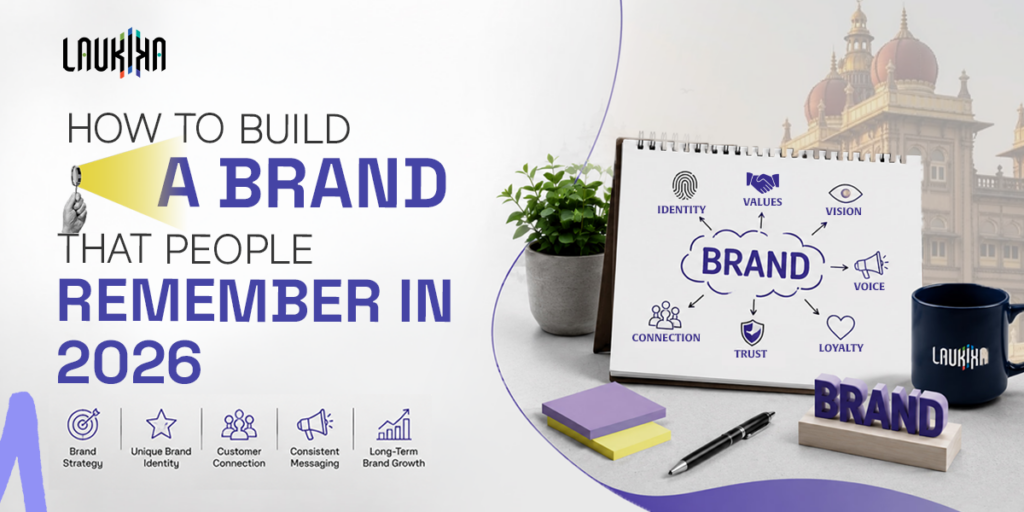
Learning how to build a brand is no longer reserved for companies with large budgets. In 2026, the businesses that win are not always the best – they are the most recognisable. Forgettable brands pay the price in every campaign they run, every customer they lose to a competitor, and every missed opportunity to be the obvious choice.
Discovery has changed too. Buyers now meet a brand through an AI summary, a chatbot response, or a comparison answer before they ever open a website. Research suggests that 31% of search queries may be answered by AI models by 2026. That means building a brand today means being understandable to people, search engines, and the AI systems assembling those answers.
This guide covers everything: purpose, audience research, brand identity, positioning, brand awareness, personal branding, AI visibility, and how to measure it all. The goal is simple – build something people can recognise, explain, trust, and remember.
What Is Brand Building and Why It Decides Your Business Growth
Brand building is the ongoing process of shaping how people recognise, understand, and feel about a business. It brings together the company’s purpose, messages, visual identity, reputation, and customer experience so that audiences can distinguish it from competitors, trust what it promises, and remember it when a relevant need arises.
When people ask what is brand building, three related ideas often get mixed together. Brand building is the broader, long-term effort to strengthen recognition and reputation. Branding is the expression of that strategy through elements such as the name, logo, tone, colours, and design system. Brand marketing is the work of taking that identity into the market through campaigns, advertising, content, partnerships, and other forms of promotion.
Brand building is therefore not a launch activity that ends once the website and logo are approved. It behaves more like a compounding asset. Each consistent interaction adds familiarity; each positive experience adds trust. Apple and Coca-Cola did not become widely recognised through one campaign. Years of repeated signals built that equity. The same principle applies to smaller companies: clarity established early can improve marketing efficiency, customer loyalty, referrals, and repeat purchases over time.
How to Build a Brand Strategy That Actually Works in 2026
A brand strategy sets the direction before design or promotion begins. If you want to build one that connects to your business goals, explore how brand strategy works as a foundation for everything that follows. It explains why the business exists, whom it is trying to matter to, and what gives customers a reason to choose it. Learning how to build a brand strategy starts with a few disciplined decisions rather than a long list of slogans.
Define the brand’s purpose and mission.
Study the people the brand needs to influence.
Examine competitors and identify a credible gap.
| Strategy Area |
Central Question |
Practical Output |
|---|---|---|
| Purpose | Why should this business exist? | Mission and guiding principles |
| Audience | Whose problem are we solving? | Customer profiles and insights |
| Competition | Why should buyers choose us? | Points of differentiation |
Define Your Brand Purpose and Mission
Start with the reason the company matters beyond selling a product. Purpose identifies the problem being solved or the change the business wants to create. The mission statement translates that intent into a short, usable line that can guide communication, hiring, service, and product choices.
A footwear company, for example, might define its purpose as helping athletes perform at their best. That is broader than “selling shoes,” but still close enough to the product to remain believable.
Mission statement example: “Our mission is to empower every athlete with high-performance footwear that makes them faster and stronger.”
The sentence identifies the audience, the offer, and the outcome. A useful mission statement is specific without becoming lengthy. It should help a new employee understand what the company is working toward and help a customer understand why the brand exists.
Understand Your Target Audience
A brand cannot be relevant in the abstract. It becomes relevant to a particular group of people, in a particular context, for a particular reason. Audience research helps uncover those details before the business commits to messages or design choices based only on internal assumptions.
Use a practical research sequence:
Map demographics and psychographics. Record age, location, income, interests, habits, values, and motivations.
Speak to customers. Interviews and surveys reveal frustrations, expectations, and the language people naturally use.
Review behaviour. Study analytics, search queries, reviews, social discussions, and sales conversations.
Build working personas. Profiles such as “Fitness Fiona” or “Tech-savvy Tom” can help teams make clearer choices.
Test before scaling. Put early messages, concepts, or prototypes in front of real people and observe what they understand.
Patterns matter more than isolated comments. When several customers describe the same concern in similar terms, that language deserves attention. Good audience insight shapes the brand’s tone, promise, channels, visual choices, and even the way an offer is packaged.
Analyze Your Competitors
Competitive analysis is not a hunt for ideas to copy. It is a way to see what customers are already hearing, which claims have become generic, and where the market may still leave room for a distinct point of view. Review three to five direct competitors across messaging, design, pricing, audience, and customer experience.
A simple comparison table can expose patterns quickly:
| Competitor | Brand Positioning / Tagline | Strengths (USP) | Weaknesses |
|---|---|---|---|
| Brand A | “Eco-fitness for everyone.” | Sustainable materials; active community | Higher price; limited styles |
| Brand B | “Affordable activewear, delivered.” | Low price; wide presence | Generic perception; moderate quality |
| Brand C | “Tech-tuned performance gear.” | Advanced fabrics; innovation | Lower recognition; niche audience |
| Brand D | “Urban style meets function.” | Fashion-led design; creator network | Smaller range; urban focus |
How to Create a Brand Identity Step by StepBrand Building Tips That Drive Real Growth
A brand identity is the set of cues people use to recognise the business: its name, voice, colours, typography, imagery, and story. Understanding how to create a brand identity means making those elements work together rather than treating each as a separate creative task. The result should feel distinctive, but it also has to function in everyday use.
Choose Your Brand Name
Choose a name people can hear once, pronounce correctly, and recall later. It should suit the brand’s personality, stand apart from competitors, and remain useful if the business expands. Before deciding, check trademarks, domains, social handles, and unintended meanings in relevant languages.
| Naming Method | Example | How It Works | Best Suited To |
|---|---|---|---|
| Descriptive | PayPal | Explains the service directly | Clear functional offers |
| Invented | Creates a distinctive new word | Technology and innovation | |
| Founder name |
Tesla |
Adds heritage and authority | Expertise-led businesses |
| Metaphoric | Amazon | Suggests scale and possibility | Ambitious category brands |
| Compound | Joins familiar ideas | Digital products and platforms |
Develop Your Brand Voice and Personality
| Trait | What It Means | Sounds Like | Avoid |
|---|---|---|---|
| Warm | Human and approachable | Clear, respectful language | Cold corporate phrasing |
| Expert | Informed and credible | Specific, useful guidance | Empty jargon |
| Motivational | Encouraging and active | Practical next steps | Exaggerated hype |
Build Your Visual Identity
Logo
Create a distinctive mark that remains clear from a favicon to a billboard.
Colours
Select a focused palette and define supporting shades for hierarchy and accessibility.
Typography
Choose readable typefaces and assign clear roles for headings, body copy, and emphasis.
Imagery
Set expectations for photography, illustration, composition, lighting, and editing.
Test the identity in real layouts, not only on a presentation slide. A strong system should remain recognisable even when the full logo is absent. Check contrast, legibility, and reproduction before approving the final files.
Write Your Brand Story
A brand story should explain why the business exists without reading like an advertisement. The simplest structure is Challenge, Journey, Promise.
Challenge: The founder could not find sustainable running shoes that performed reliably.
Journey: The team tested materials, refined designs, and worked through manufacturing barriers.
Promise: Runners can now choose performance without compromising their environmental values.
Keep the customer close to the centre of the story. The founder’s experience matters because it led to a useful outcome for someone else. Specific details make the narrative believable; inflated claims usually make it sound less personal.
Create a Brand Style Guide
A brand style guide turns decisions into a reference people can actually use. It prevents the identity from changing every time a new employee, freelancer, vendor, or agency touches it.
Include:
Logo versions, spacing, placement, and misuse rules
Colour specifications and accessibility guidance
Typography hierarchy and formatting examples
Voice, tone, terminology, and writing dos and don’ts
Photography, illustration, iconography, and layout principles
Mission, positioning statement, audience, and brand story
Templates for presentations, documents, and social posts
Keep the guide accessible and update it when the business evolves. A forgotten PDF cannot protect consistency. Assign one person to maintain the current version and remove outdated templates from circulation.
Brand Positioning Strategy That Actually Works
A brand positioning strategy defines the place a company wants to occupy in the customer’s mind. It is not a clever tagline or a broad claim such as “best quality.” Positioning brings together the target audience, the need being addressed, the category, the distinctive benefit, and the proof behind that benefit. Done well, it gives the rest of the brand a clear direction.
What Is Brand Positioning
How to Write a Brand Positioning Statement
A positioning statement is an internal decision-making tool. It should be precise enough to guide messages, products, partnerships, and campaigns.
“For [target audience] who [need or opportunity], [Brand] is the [category] that [unique benefit], because [proof or reason to believe].”
If the sentence could describe most competitors, it needs another round of work.
Brand Positioning Examples That Actually Work
Nike’s position combines athletes, performance, quality, and innovation. Apple’s combines advanced technology, design, and a forward-looking approach to products and business. Both are clear about the value they want customers to associate with the name.
Example: “For environmentally conscious homeowners, EcoVolt Solar is the solar company that offers efficient, affordable energy solutions because it combines advanced technology with community-funded pricing.”
Brand Building Tips That Drive Real Business Growth in 2026
Be Consistent Across Every Channel and Touchpoint
Recognition depends on repetition. The logo, colours, typography, tone, and central message should feel connected across the website, social media, packaging, presentations, emails, and internal documents.
That does not mean every asset must look identical. It means people should be able to tell that the same brand made them. Review high-traffic touchpoints regularly and correct the small inconsistencies that accumulate over time.
Lead with Storytelling, Not Product Features
Feature lists explain what a product contains. Stories show why it matters.
This is where
digital storytelling
becomes one of the most powerful tools a brand can use to build emotional
connection with its audience.
Use customer journeys, founding experiences,
behind-the-scenes challenges, or moments of change to give the brand a
human context.
Research found that 75% of consumers are more likely to remember a brand
linked to a meaningful story. The strongest stories still need substance,
though. Make the customer the protagonist and the brand the useful guide
that helps
Use Social Proof and Trust Signals Everywhere
Buyers often look for reassurance before they act. Reviews, testimonials, case studies, star ratings, credible endorsements, customer photographs, and relevant media mentions can reduce that uncertainty.
Place proof near the decision it supports. A detailed case study belongs near a service enquiry; a recent review belongs near a product choice. Specific, verifiable evidence is more persuasive than a wall of generic praise.
Build a Community Around Your Brand
A community gives people a reason to stay connected when they are not actively buying. It might take the form of a newsletter, private group, forum, event series, Q&A, workshop, or member programme.
Useful communities are built around a shared interest, not constant promotion. Invite feedback, recognise thoughtful contributors, and create occasions for members to learn from one another. Over time, participation can support advocacy, referrals, repeat purchases, and user-generated content.
How to Build Brand Awareness That Gets You Found in 2026How to Build a Brand From Scratch
Knowing how to build brand awareness is not the same as chasing the largest possible reach. The real task is to appear in the right places, often enough, with enough consistency that the brand becomes familiar. Content, social platforms, creators, and earned media each contribute a different kind of exposure.
Content Marketing and Organic SEO
Publish articles, guides, videos, and resources that answer questions your audience already has. Search optimisation helps those assets continue working after the initial promotion ends, while useful content gives people a reason to return.
Track organic rankings, branded search volume, direct traffic, and time spent on key pages. Update strong content when facts, examples, or search behaviour change. A useful library can build recall gradually and can also feed AI-generated answers.
Social Media and Creator Partnerships
Choose platforms based on audience behaviour rather than fashion. LinkedIn may suit a B2B consultancy; Instagram or TikTok may be better for a visual consumer brand. The format should suit the platform instead of being copied unchanged everywhere.
Creator partnerships work best when relevance and trust are stronger than raw follower count. Measure mentions, shares, engagement, and the quality of traffic generated. Social creates attention quickly, but searchable owned content gives that attention somewhere useful to go.
Digital PR and Earned Media
Digital PR builds visibility through journalists, publications, bloggers, and industry authorities. Interviews, research, contributed articles, expert commentary, and genuinely newsworthy announcements can earn coverage without buying the space.
That coverage carries third-party credibility and may also produce backlinks or referral traffic. Useful measures include media mentions, share of voice, link quality, and the number of relevant visitors reaching the site from earned coverage.
| Channel | Best For | Typical Tactics | Key Metrics |
|---|---|---|---|
| Content Marketing & SEO | Long-term discovery and recall | Blogs, videos, guides | Rankings, traffic, dwell time |
| Social & Creator Marketing | Reach and engagement | Partnerships, campaigns, interactive content | Followers, shares, impressions |
| Digital PR & Earned Media | Credibility and exposure | Interviews, research, contributed articles | Mentions, backlinks, referrals |
Paid promotion can accelerate a good message, but it cannot repair a vague brand. Use it to amplify proven content, retarget interested audiences, and compare different messages. The business should remain understandable and credible after the campaign ends.
Awareness is usually cumulative. Someone may notice a creator post, encounter the company again in search, read an article, and finally trust it after seeing an independent mention. Plan those exposures as parts of one system. The same name, position, visual cues, and central idea should become more familiar each time.
How to Build a Strong Personal Brand in 2026
Learning how to build a personal brand means making your expertise, perspective, and professional reputation easier to recognise. This matters to founders, consultants, creators, executives, and employees alike. Buyers and employers often research a person before making contact, and AI-led discovery is adding another layer to that process.
Personal Brand vs. Business Brand
A personal brand is tied to an individual’s name, ideas, experience, and reputation. A business brand belongs to an organisation and is expected to operate beyond any one person.
| Personal Brand | Business Brand |
|---|---|
| The individual is the public face | The company is the public identity |
| Built through expertise and personality | Built through products, systems, and experience |
| Harder to separate from the founder | Easier to scale or transfer |
| Suits consultants, creators, and speakers | Suits organisations with teams and offers |
How to Position Yourself as an Expert
Expert positioning comes from useful work that other people can see, verify, and remember.
Publish articles, videos, or resources that solve specific problems.
Speak at webinars, events, workshops, and podcasts.
Collect relevant credentials, case studies, and endorsements.
Collaborate with respected peers and contribute to industry discussions.
Pick a subject area narrow enough to become associated with your name. Consistency is more convincing than occasional bursts of content on unrelated topics.
Best Platforms for Personal Branding in 2026
Professional insights, articles, commentary, and network building
YouTube
Tutorials, analysis, demonstrations, and searchable video
X or Mastodon
Timely ideas and industry discussion
Personal website
A permanent home for credentials, services, and long-form content
Podcasts and newsletters
Deeper, recurring relationships with a focused audience
How to Build a Brand That AI Search Engines Cite and Recommend
Brand building AI search visibility depends on whether automated systems can find clear, consistent, and credible information about the company. A buyer may now see an AI-generated recommendation before a search result or website visit. The brand therefore needs a strong public footprint, not only a polished homepage.
Why AI Search Visibility Matters for Brand Building Now
AI assistants increasingly handle discovery, comparison, and recommendation questions. When a company is missing from the sources those systems rely on, it may be left out of the answer as well.
Data callout: Research suggests that roughly 31% of search queries could be answered by large language models by 2026.
Improving brand visibility AI Overviews starts with becoming a recognisable and well-supported entity online.
How to Make Your Brand Machine-Readable and Citable
Make key information easy for systems to identify and cross-check.
Add relevant Organization, Product, Service, and FAQ schema.
Keep website and business-profile information accurate.
Publish clear service pages, guides, FAQs, and original insights.
Earn reputable third-party mentions and backlinks.
Use the same official name, descriptions, and contact details across platforms.
Machine readability does not replace good writing. It helps systems interpret and verify the writing that is already there.
How AI Systems Learn Who Your Brand Is
AI systems form an understanding of a brand from connected public evidence. That can include the company website, structured data, knowledge bases, reviews, media coverage, video transcripts, directories, and user-generated mentions.
When several reliable sources connect the same name with the same services, expertise, location, and reputation, confidence increases. Thin or contradictory information has the opposite effect. Consistency across the web is therefore part of brand management, not only a technical SEO task.
ChatGPT vs. Google AI Mode vs. Perplexity
| Platform | Primary Citation Sources | Best Content Format | Brand Entry Point |
|---|---|---|---|
| ChatGPT | Web sources and licensed data | Detailed explainers and Q&A | Relevant user prompts |
| Google AI Mode | Google index and Knowledge Graph | Concise pages, lists, and FAQs | Search queries |
| Perplexity | Current web pages and news | Factual, referenced content | Cited answers |
When to Work with a Brand Building Firm
A brand building firm can be useful when the work requires research, positioning, messaging, identity design, and implementation skills that are not available internally. This often happens during a launch, rebrand, merger, market expansion, or period of rapid growth.
In-House vs. Agency: How to Decide
An in-house team brings daily access, cultural knowledge, and direct ownership. An agency offers specialist talent, an external point of view, and the ability to assemble a wider team for a concentrated project. Neither model is automatically better.
Use three signals:
Expertise: Does the current team include experienced strategists, writers, researchers, and designers?
Capacity: Can they complete the work without pushing aside essential day-to-day priorities?
Scope: Is the need ongoing, or is it a defined launch, rebrand, or expansion project?
A hybrid model often works well. An internal brand owner can protect continuity while an external team handles research, identity, campaigns, or major transitions. That arrangement keeps knowledge inside the business without expecting one small team to cover every specialist discipline.
What to Look For When Hiring a Brand Agency
Look beyond the visual polish of the portfolio. A serious agency should be able to explain the thinking behind the work and show how it connected to an audience, market problem, or business objective.
Review:
Relevant branding and industry experience
Clear case studies, not only finished images
Research, positioning, messaging, and implementation capabilities
Client references or credible testimonials
Transparent proposals, pricing, timelines, and responsibilities
A communication process that includes useful questions and honest feedback
Respect for the company’s mission, audience, and commercial reality
Evidence that the agency can support rollout after the initial presentation
Be cautious when an agency jumps directly to colours and logo ideas. Good identity work begins with understanding the market, the offer, the audience, and the decision the brand needs to influence.
How to Measure Brand Building Success
Brand performance cannot be understood through sales or campaign clicks alone. Measure whether people know the brand, what they think about it, whether they return, and whether search and AI systems recognise it accurately.
Brand Awareness Metrics
Awareness metrics show whether the brand is becoming easier to find and remember. Look at trends over time rather than one-off campaign spikes, and compare results with seasonal patterns or changes in media spend.
Social reach and mentions
Branded search volume
Direct website traffic
Media mentions
Brand Equity and Perception Metrics
Net Promoter Score
Customer sentiment
Brand loyalty
Repeat purchase rate
Attribute-based brand surveys
AI Visibility and Citation Tracking
Track the brand’s presence in AI-generated answers for category, service, problem, and comparison queries. Use a stable set of prompts and repeat the exercise at regular intervals, since answers can vary by platform, location, and date.
Mentions in ChatGPT, Google AI Mode, and Perplexity
Presence in AI Overviews and featured snippets
Accuracy of Knowledge Panel information
Referral traffic from AI tools
Share of citations compared with competitors
Frequently Asked Questions
What is brand building?
How long does it take to build a brand?
What is the difference between brand identity and brand strategy?
Can we build a strong brand with a nominal budget?
How is building a personal brand different from a business brand?
How do you get your brand cited in AI search results?
How do you build a brand from scratch with no prior experience?
Start by defining your audience, the problem you solve, and what makes you different. Then choose a name, build a simple visual identity, and publish content consistently. Clarity matters more than budget.
What is the difference between a brand and a logo?
A logo is a visual mark. A brand is the full experience – the promise, personality, and trust people associate with that mark. Your logo identifies you. Your brand makes people choose you.
Conclusion
Understanding how to build a brand in 2026 requires more than an attractive identity. It calls for clear strategy, consistent execution, credible proof, and experiences that reinforce the same promise. Two shifts make this particularly important: people have less attention to spare, and AI-led search increasingly influences which businesses they encounter first.
Define the purpose, understand the audience, choose a position the company can prove, and make the brand recognisable across every touchpoint. Then measure human perception alongside machine visibility. Businesses that invest in clarity and consistency now will be better placed to earn trust, preference, and recommendation as discovery continues to change.
Ready to build a brand that people remember? Connect with Laukika and get started today.
Recent Blogs
How Branding and Digital Storytelling Build Strong Entertainment Brands
The entertainment landscape has never been more crowded. With OTT platforms, streaming services, television, social media and short-form video all

Short Stories. Big Impact. How Micro-Series Are Changing OTT Entertainment in India
India’s entertainment landscape is changing rapidly – audiences have access to more films, shows, series, and digital content than ever