Need AI SEO Checklist for 2026? Here’s the latest

The rules of search have changed permanently.
This AI SEO Checklist begins with a simple truth: for over two decades, SEO meant one thing: rank higher on Google’s blue-link results pages. But in 2026, that playbook is no longer enough. More than 50% of Google searches now show an AI Overview, and ChatGPT alone has between 800 and 900 million weekly active users. The way people find information, products, and brands has fundamentally shifted.
Today, users don’t just search they ask. They type conversational questions into ChatGPT, Gemini, and Perplexity and expect direct, synthesised answers. If your content isn’t being cited in those answers, you are effectively invisible to a fast-growing segment of your audience.
This is where AI SEO and more specifically, Generative Engine Optimization (GEO) comes in. This blog covers everything you need to know: what GEO is, why it matters, how it works, the top strategies for 2026, and the tools you need to implement it successfully. Whether you’re a marketer, business owner, or SEO professional, this checklist will help you adapt and win in the era of generative search.
What Is Generative Engine Optimization (GEO)?
Generative Engine Optimization (GEO) is the practice of structuring your content and digital presence so that AI platforms such as ChatGPT, Google AI Overviews, Perplexity, and Gemini retrieve, cite, and recommend your brand when generating answers to user queries.
Unlike traditional SEO, which focuses on ranking in search engine results pages, GEO focuses on being cited in AI-generated answers. Both are complementary strategies for comprehensive visibility.
The term was formally introduced in academic research. Princeton, Georgia Tech, and IIT Delhi published the foundational GEO paper in 2024, and it entered mainstream marketing vocabulary in 2025. By early 2026, most enterprise marketing teams have a GEO initiative.
Here’s how GEO differs from traditional SEO in practice:
1. Traditional SEO:
Your link appears in position 3 on a results page users may or may not click.
2. Generative Engine Optimization:
An AI engine cites your brand, statistic, or definition directly in its generated answer users consume your content without clicking, but they associate the knowledge with your brand.
3.Zero-click doesn’t mean zero value:
Brand recall, authority, and assisted conversions all increase when your content is cited in AI answers.
Research demonstrates that GEO can boost visibility by up to 40% in generative engine responses.
Why GEO Is the Future of SEO?
We are in the middle of a seismic shift in how people discover information online. The data is unambiguous, and the pace of change is accelerating.
User behavior is undergoing a fundamental shift many users are bypassing traditional search engines and getting direct answers from chatbots and voice assistants. Reliance on search engines is expected to drop by 25% by 2026. This is not a distant prediction; it is already happening.
Why does this make GEO the future of SEO?
In 2025, 60% of searches ended without a click, and the click-through rate at position 1 when an AI Overview is present is only 2.6%.
Traffic from AI chatbots to retailers exploded by over 520% between 2024 and 2025, and visitors from AI are 4.4 times more qualified than those from traditional search. The global GEO market was $886 million in 2024 and is expected to reach $7.3 billion by 2031, a compound annual growth rate of 34%, making it one of the fastest-growing segments in digital marketing.
Only 34% of companies have trained their teams in GEO, revealing a significant skills gap and a first-mover opportunity for those who act now.
In 2026, AI search engines are estimated to power 50% of queries worldwide, with McKinsey predicting that figure will reach 75% by 2028.
Core Components of GEO
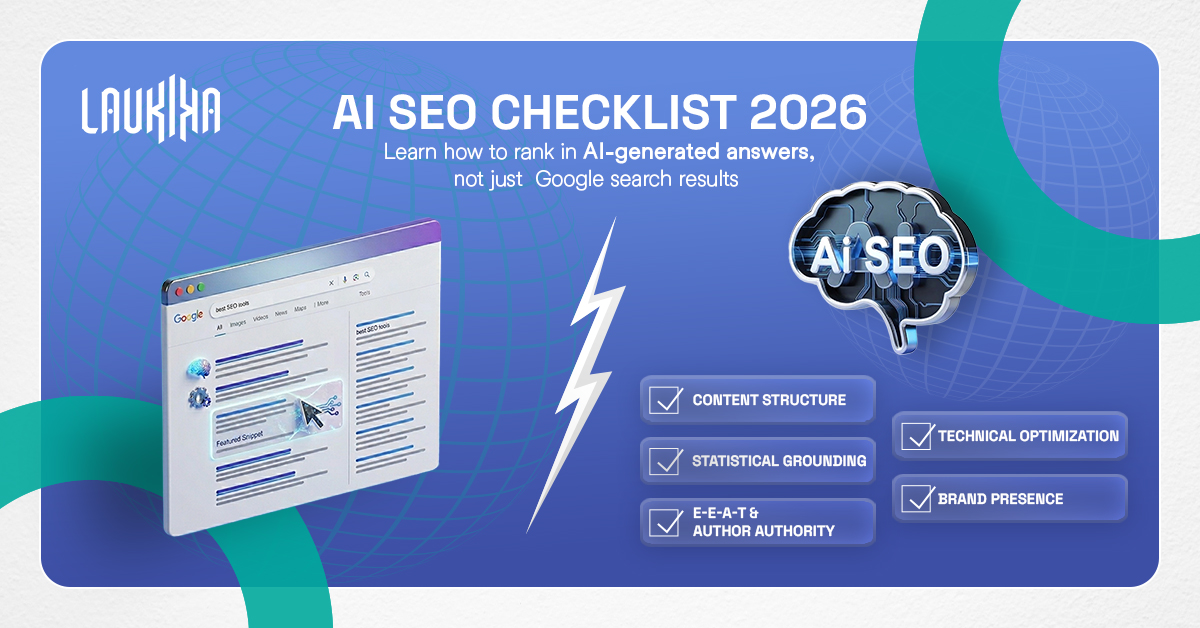
Effective GEO is not a single tactic it is a multi-layered strategy. An effective Generative Engine Optimization strategy rests on five connected principles that work together to maximise AI visibility, addressing how AI systems discover, evaluate, and reference your brand.
Here are the 5 core components explained:
1. Content Strategy and Structure:
Publishing information that AI systems can discover, understand, and extract for answers is the bedrock of GEO. This means writing with clear H2 headers phrased as direct questions, providing self-contained factual sentences, and structuring content so that AI engines can extract complete answers without needing broader context. A header that reads “What Is GEO?” is more likely to be cited for the query “what is generative engine optimization” than a vague heading like “GEO Overview.”
2. Statistical Grounding and Original Data:
Every factual statement must be a complete, self-contained sentence. Vague phrasing like “many companies benefit from AI” is invisible to LLMs; precise phrasing with specific percentages gets cited. Include proprietary research, case studies, and up-to-date statistics wherever possible.
3. E-E-A-T and Author Authority:
AI systems heavily weight expertise, experience, authoritativeness, and trustworthiness. Content attributed to credible authors with verifiable credentials, published on authoritative domains, is significantly more likely to be cited in AI-generated responses.
4. Technical Optimisation:
Ensuring AI crawlers can fully access and process your content is non-negotiable. This includes properly configured robots.txt files, structured data and schema markup (especially FAQ schema, HowTo schema, and Article schema), fast page load speeds, and clean site architecture.
5. Brand Presence and Earned Mentions:
Customer reviews on G2, Capterra, or Trustpilot, industry journalists citing your company, and community discussions on Reddit or Quora where users recommend your solution all send credibility signals that AI systems use to evaluate your authority.
How GEO Works in Practice?
Understanding the mechanics of how generative engines retrieve and cite content helps you optimise more intelligently. At its core, GEO is about making your content the most logical, verifiable, and accessible answer available to an AI model when it constructs a response.
LLMs do not “prefer” content the way a human reader does they extract structured, verifiable, self-contained claims and weigh them against signals of authority, freshness, and consensus. Here is a practical step-by-step breakdown:
Identify the AI platforms your audience uses most whether that is ChatGPT, Perplexity, Google AI Overviews, or Gemini and prioritise optimisation accordingly.
Audit your existing content to identify pages that answer high-intent questions, then restructure them with direct H2 questions followed immediately by standalone, factual answers.
Add specific, citable statistics to every key claim in your content vague statements are not picked up by LLMs, but precise data points are.
Implement structured data markup (FAQ schema, Article schema, HowTo schema) so AI crawlers can parse your content more efficiently.
Build cross-platform authority by earning mentions on third-party sites, industry databases, Wikipedia, review platforms, and high-authority publications. Boost signals by earning features in authoritative databases, including top-ten lists, review sites, industry directories, and Wikipedia, as AI tools pull from top-ranked sources.
Keep content fresh: AI retrieval systems weight recent content for time-sensitive queries, and articles with visible “Last Updated” signals and current statistics outperform evergreen content for fast-moving topics.
AI SEO Checklist for GEO Strategies That Go Beyond the Basics
The most effective GEO strategies in 2026 go beyond basic content optimisation they require a holistic approach to digital authority, entity building, and multi-platform visibility. In 2026, the most successful marketers are those who have moved beyond rigid checklists and treat GEO as a cycle of constant experimentation, because generative models are probabilistic and what worked for a competitor may not work for you.
Here are the five highest-impact strategies to prioritise:
1. Answer-First Content Architecture:
Structure all key pages so that the very first sentence after each H2 header is a direct, complete, standalone answer to the implied question. AI engines value clean, clear structure your H2s should mirror the exact questions your audience is asking, and the first sentence that follows must be a definitive, standalone answer.
2. Build a Multi-Source Brand Footprint:
Your brand cannot rely solely on its own website. You are no longer just managing a website, but a digital entity’s reputation across a vast, interconnected web of LLMs, community forums, and AI platforms. Actively build brand mentions across Reddit, LinkedIn, YouTube, industry publications, and review platforms.
3. Target Long-Tail and Conversational Queries:
AI search is driven by natural language. Optimise for the specific questions your audience types conversationally: “What is the best AI SEO tool for small businesses?” performs better in generative search than broad keyword targeting.
4. Leverage Schema Markup Aggressively:
Implement FAQ, HowTo, Article, and Organisation schema across your site. Structured data gives AI systems explicit signals about the nature, context, and credibility of your content.
5. Conduct Regular AI SEO Audit Checklists:
Track AI citation share how often your brand is named in AI answers alongside citation sentiment and zero-click displacement. These are the KPIs of GEO in 2026, and you need both traditional SEO metrics and AI visibility metrics to understand your full organic search presence.
Common Challenges in GEO Implementation
Despite the clear opportunity, many businesses struggle to get started with GEO. Only 34% of companies have trained their teams in GEO, and only 28% of marketers are trained in GEO prompt engineering, even though 57% of professionals require AI training. Understanding the common pitfalls helps you avoid them.
1. Attribution complexity:
Traditional web analytics tools are not built to track AI-driven referral traffic accurately. Attributing conversions and traffic to AI citations requires new measurement frameworks and specialised GEO tools.
2. Algorithm opacity:
AI models operate as black boxes they do not publish clear ranking or citation criteria, making it difficult to predict precisely which content will be cited.
3. Content update overhead:
AI retrieval systems favour recent content, meaning teams must treat content as a living document that continues to earn trust. Maintaining content freshness across an entire site requires significant ongoing resource investment.
4. Budget and skills gaps:
The main obstacle to GEO adoption is lack of budget, cited by 34.1% of teams, and this is paradoxical given GEO’s proven ROI of +22%.
5. Multi-platform fragmentation:
Each generative engine: ChatGPT, Gemini, Perplexity, and Google AI Overviews has distinct characteristics, citation behaviours, and content preferences. Optimising for all simultaneously requires a coordinated, platform-aware strategy.
Measuring GEO Success
Traditional SEO metrics like keyword rankings and organic click-through rates do not fully capture GEO performance. Measuring AI SEO success requires a new set of KPIs designed for the generative search environment.
Together, these metrics help you understand not just whether you’re visible, but how your brand is being positioned inside AI-generated responses. You need both traditional SEO metrics and AI visibility metrics to understand your full organic search presence in 2026.
The five core GEO metrics to track are:
1. AI Citation Share:
The percentage of relevant queries in your niche where your brand is mentioned or cited in AI-generated answers the primary GEO visibility KPI.
2. Citation Sentiment:
How your brand is described in AI responses positively, neutrally, or negatively. Sentiment analysis tools like Semrush AI Toolkit and Profound can surface this data.
3. Zero-Click Displacement Rate:
The volume of organic traffic lost or gained as a result of AI Overview appearances for your target queries.
4. AI Referral Traffic:
Direct traffic arriving from AI platforms (trackable via UTM parameters and GA4 channel groupings), which has grown by over 520% for retail categories between 2024 and 2025.
5. Organic-AI Overlap Score:
The proportion of your keywords where you appear in both traditional organic results and AI Overviews a high overlap score indicates strong foundational authority.
Future Outlook: GEO and AI-Driven Search
The trajectory of AI-driven search points clearly one direction: generative engines will increasingly mediate between users and information, making GEO a non-negotiable element of any digital marketing strategy.
Citation authority, like domain authority before it, compounds over time. The brands that invest in GEO in 2026 will be the brands that AI systems cite in 2027, 2028, and beyond.
The window for first-mover advantage is open but it will not remain so indefinitely.
Key trends shaping the future of AI SEO include:
Real-time personalisation at scale:
AI engines will increasingly tailor responses to individual session context, prior behaviour, and conversational history rewarding content structured for multiple knowledge levels.
Multimodal GEO:
Optimisation will expand beyond text to include images, video, audio, and interactive content as AI systems become capable of processing and citing all content formats.
AI agent proliferation:
44% of companies experimented with AI agents between August and December 2025 and as autonomous AI agents conduct research and make purchasing decisions on behalf of users, machine-readable content will become even more critical.
Retrieval-Augmented Generation (RAG) expansion:
RAG architectures, which allow AI systems to retrieve live web data before generating responses, will continue to grow placing greater premium on structured, authoritative, and frequently updated content.
New SEO roles emerging:
AI will spur entirely new SEO roles, including Prompt SEO Specialist and AI Attribution Analyst, reflecting the growing complexity of generative search optimisation.
Convergence of SEO and GEO:
Since 99% of AI Overview citations come from the organic top 10, and 87% of ChatGPT citations correspond to Bing’s top results, traditional SEO remains the indispensable foundation for GEO success.
Frequently Asked Questions
Conclusion
The era of AI-driven search is not coming it is already here. GEO has moved from an experimental discipline to a strategic imperative.
With over half of all searches now delivering AI-generated summaries, and traditional organic click-through rates declining sharply, businesses that rely on conventional SEO alone are leaving significant visibility and revenue on the table.
The good news is that GEO is actionable today. Start by auditing your existing content for answer-first structure, adding specific citable statistics, implementing schema markup, and building brand authority across third-party platforms. Invest in the right AI SEO tools to track your citation share and monitor how your brand is represented in AI-generated responses. Combine these efforts with a strong traditional SEO foundation because the two strategies reinforce each other.
Start optimising your content for GEO today because in generative search, the brands that get cited are the brands that get chosen.