
When multiple pages on the same website target similar search terms, keyword cannibalization can quietly create problems for your SEO performance. At first, publishing several articles around the same topic may seem like a smart way to cover more searches. But if those pages serve the same intent, they can end up competing with one another instead of strengthening your website’s visibility.
This doesn’t necessarily mean Google will penalise your website. The bigger issue is that search engines may struggle to decide which page is the best result for a particular query. As a result, rankings can shift between pages, the wrong URL may appear in search results, and the authority you’ve built around a topic can become spread across multiple pages. This can also make it harder to track which content is actually performing well.
The good news is that you can usually resolve these issues without starting from scratch. By finding pages with overlapping intent, deciding which URL should be the primary resource and adjusting your content and internal links, you can give each page a clearer role. A well-planned approach helps your content work together rather than compete for the same space in search results.
The Client
What makes PointAI particularly relevant to modern commerce is its focus on moving beyond conventional digital product presentation. E-commerce has traditionally relied on static photographs, fixed product views, and standardized descriptions. PointAI’s technology attempts to make the experience more interactive by allowing products to be simulated in the context of the customer and the shopping journey.
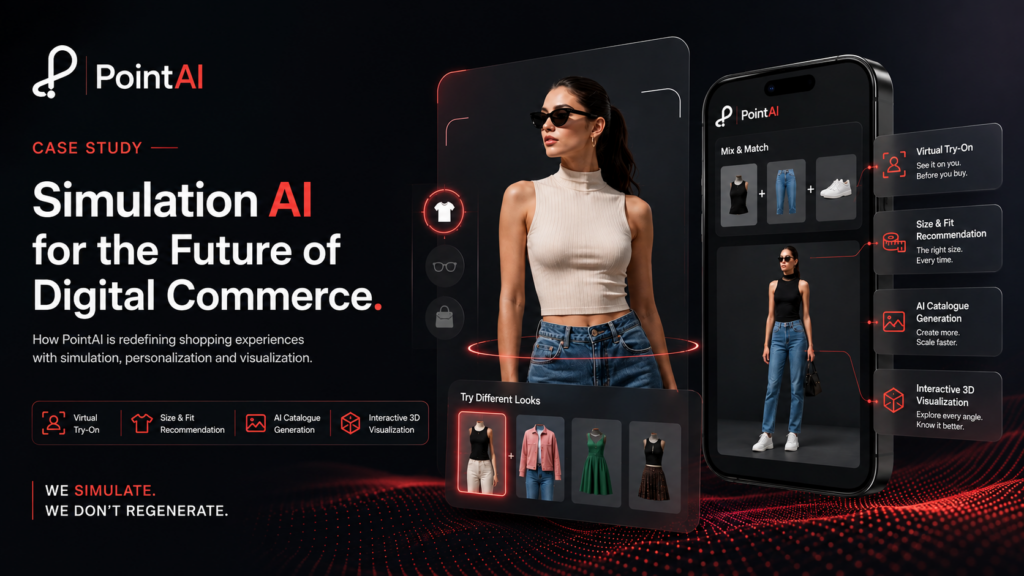
Its current communication places strong emphasis on Simulation AI and digital-twin technology. For example, PointAI describes its Virtual Try-On platform as creating a digital representation of the user and enabling realistic visualization of garments while preserving details such as fit, fabric, texture, and drape.
This gives PointAI a position that sits at the intersection of AI, fashion technology, computer vision, and digital commerce.
But having sophisticated technology is only one part of building a strong technology brand. The bigger challenge is making that technology understandable.
The Challenge
PointAI operates in a category where technological capability can quickly become difficult to communicate.
Terms such as AI, Computer Vision, digital twins, 3D visualization, virtual try-on, simulation, and personalization are powerful from a technology perspective. But for a customer, retailer, or e-commerce decision-maker, technical terminology alone does not explain why the technology matters.
The audience is not necessarily asking: “How does the AI model work?” They are asking: “What will my customer actually experience?”
That distinction became central to the communication challenge.
For example, saying that PointAI offers Virtual Try-On communicates a feature. It does not fully communicate the experience behind it. The more meaningful story is that a shopper can move from simply looking at a garment to visualizing that garment on themselves.
Similarly, Size & Fit Recommendation is not simply another AI capability. The customer-facing value is helping remove uncertainty from an online fashion purchase.
Mix & Match is not just about combining products. It is about helping shoppers imagine complete looks.
Interactive 3D is not simply a technical rendering capability. It is about allowing a shopper to explore a product rather than merely look at a single image.
This created a communication gap between what PointAI had built and how easily an audience could understand it.
The task, therefore, was not to simplify the technology itself. It was to simplify the story around the technology.
The communication needed to move away from feature descriptions and toward experiences, use cases, and outcomes. PointAI needed a narrative that could work across different products without making each product feel like a separate technological offering. That meant finding one strategic idea capable of connecting the entire ecosystem.
The Strategic Shift
The strategic shift began with changing the question.
Instead of building communication around “What technology does PointAI have?”, we reframed it around “What does PointAI’s technology make possible?”
This sounds like a small difference, but strategically it changes everything.
A technology-first narrative naturally leads to features, technical specifications, AI terminology, and product descriptions. An experience-first narrative starts with the real-world problem.
A shopper cannot try on a garment online — simulation makes virtual try-on possible. A shopper is uncertain about size — AI-powered fit experiences can help make that decision more informed. A shopper wants to understand how products work together — Mix & Match makes those combinations visual. A shopper wants to explore a product beyond one static image — Interactive 3D creates a more immersive way to examine it.
This approach gave every PointAI product a clear role within a larger customer journey.
The strategic idea became: don’t lead with what the AI does. Lead with what the customer can now do because of the AI.
That also changed the role of visual storytelling. Instead of explaining technology through abstract graphics, the communication could demonstrate the transformation. A product becomes a virtual experience. A body becomes a digital representation. A size question becomes a recommendation. Individual products become complete combinations. A static catalogue becomes a more dynamic visual commerce system.
This made PointAI easier to understand without reducing the sophistication of its underlying technology. It also created a more scalable brand narrative. Whether the audience encounters Virtual Try-On, fit recommendation, catalogue generation, or 3D visualization, they encounter the same fundamental promise: PointAI uses AI to simulate possibilities that were previously difficult to experience digitally.
That became the foundation for the next and most important piece of the brand story.
The Core Brand Thought: We Simulate. We Don’t Regenerate.
“WE SIMULATE. WE DON’T REGENERATE.” became the central thought around which the PointAI brand narrative could be built.
The strength of this idea lies in its ability to communicate a technological distinction through a simple human concept.
Generative AI is commonly understood through the idea of creating something new from a prompt. PointAI’s communication takes a different route.
Its Simulation AI positioning is about representing how products, people, fit, fabric, and interactions can behave within a digital environment. In its current public communication, PointAI emphasizes simulation of garments across body shapes while maintaining product characteristics such as fabric, texture, fit, and drape.
That distinction matters significantly in commerce. In e-commerce, visual accuracy is not simply a creative advantage. It can influence how confidently a customer evaluates a product.
A fashion retailer does not only need an attractive image. It needs the digital experience to communicate something close to the physical product. How does the garment look? How does it sit on the body? How does it drape? How might it work with another product? How does a shopper interact with it?
The stronger the simulation, the more the digital experience can begin to approximate aspects of the physical shopping journey.
That is why the phrase “We Simulate. We Don’t Regenerate.” works as more than a tagline. It becomes a communication filter. Instead of asking, “How do we make this look like AI?”, the question becomes: “How do we show what PointAI can realistically simulate?”
The answer is found in the experience — a shopper seeing a garment on themselves, a customer exploring fit, a user creating different outfit combinations, a product being examined through interactive 3D, a fashion brand producing visual catalogue assets at scale.
The technology remains important—but it stays behind the experience. And that is ultimately the role of the brand thought: PointAI is not asking people to admire AI. It is showing them what becomes possible when AI can simulate commerce more realistically.
That is where the PointAI story becomes bigger than a collection of AI products. It becomes a story about making digital commerce behave more like real commerce.
Our Creative Approach: Show, Don’t Explain
Once the strategic idea was established, the creative rule became straightforward: show, don’t explain.
Complex AI becomes easier to understand when people can see the transformation. Instead of writing several paragraphs about what Virtual Try-On does, show a shopper moving from a product page to a realistic representation of themselves wearing the garment. Instead of describing personalization abstractly, show how a customer’s information can lead to a more relevant recommendation. Instead of explaining 3D technology through technical terminology, show the product being explored from multiple perspectives.
The communication therefore becomes visual-first and outcome-focused. The audience does not need to understand every technical layer. They only need to understand what the technology makes possible.
Product Storytelling Framework
To maintain consistency across the portfolio, we developed a simple product storytelling framework: Problem → Simulation → Experience → Value.
Every product starts with a familiar commerce problem, demonstrates what PointAI simulates, shows the resulting experience, and then connects that experience to a meaningful business or customer benefit.
Virtual Try-On: From “See the Product” to “See Yourself In It”
Online fashion has always had one fundamental limitation: customers can see the product, but they cannot physically experience it before purchasing.
PointAI’s Virtual Try-On shifts that experience toward personal visualization. The customer does not simply look at another model wearing the product. The idea is to visualize the product on themselves.
PointAI currently positions its VTO around digital-twin technology, body measurements, product accuracy, and rapid virtual try-on. Its public communication also highlights applications across different fashion categories.
The storytelling opportunity is therefore powerful: from “Does this product look good?” to “Can I see myself wearing it?” That is a much more human way to communicate AI.
Size & Fit Recommendation
Seeing a product is only part of the purchase decision. For fashion e-commerce, customers also want confidence around size and fit.
This creates another opportunity for PointAI’s communication: instead of presenting Size & Fit as another technical AI capability, position it around decision confidence.
The narrative becomes: Customer information → AI analysis → Fit recommendation → More informed purchase. The technology stays behind the experience. The customer simply gets a clearer answer.
Mix & Match
Fashion shopping is rarely about one product in isolation. A shopper may like a shirt but wonder how it works with trousers, shoes, accessories, or another layer.
Mix & Match changes the conversation from individual products to complete possibilities. The creative direction should therefore show the transformation from separate product choices into a complete look. This makes the feature immediately understandable without requiring a technical explanation.
AI Catalogue Generation
For brands, the challenge is often different. E-commerce businesses need large volumes of product imagery and content while maintaining consistency across their catalogue.
AI Catalogue Generation addresses the visual production side of commerce by helping create product-focused catalogue outputs at scale. The storytelling should therefore focus on scale, consistency, and speed of visual merchandising, rather than presenting AI generation as the story itself.
Interactive 3D Visualization
Static product images provide a limited perspective. Interactive 3D creates an opportunity for shoppers to explore a product more actively.
The communication sequence becomes simple: Look → Rotate → Explore → Understand. For products where details, structure, shape, and physical form matter, the experience can help move digital shopping closer to product exploration.
From Four Products to One Big Story
One of the most important strategic decisions was not to communicate these solutions as disconnected products.
Virtual Try-On. Size & Fit. Mix & Match. AI Catalogue Generation. Interactive 3D.
On their own, each is a product story. Together, they represent something much bigger: a more experiential model of digital commerce.
That becomes the master narrative for PointAI. The brand is not simply offering multiple AI tools. It is building technology that can help brands simulate parts of the real-world shopping experience digitally. That gives the portfolio a stronger sense of unity.
Visual Language
The visual language needed to reflect that same balance. Too much technology would make the brand feel abstract. Too much lifestyle imagery would hide the technology.
The solution was to combine the two: real people, real products, realistic simulations, digital interfaces, and commerce environments.
This creates a visual world where technology feels advanced but the result feels familiar. A shopper can immediately understand the scenario. A business decision-maker can immediately understand the application. And PointAI’s technology becomes the invisible engine connecting the two.
The Creative Rule: Don’t Show AI. Show What AI Makes Possible.
This became the most important filter for the communication system.
Do not make the algorithm the hero. Make the experience the hero.
Don’t show a complicated AI diagram when you can show a customer trying on a garment virtually. Don’t explain personalization for several sentences when you can demonstrate a personalized recommendation. Don’t talk endlessly about 3D when you can let the viewer see the product being explored.
The principle is simple: technology is the enabler. The experience is the story.
Social Media Strategy
Once the master narrative was established, it could extend naturally into social media.
The objective was not to post random AI updates. The objective was to build an identifiable PointAI communication ecosystem around Simulation AI and the future of commerce.
Content Territories
The content system can revolve around four broad territories:
- Product Education – Breaking down what PointAI products do through simple visual examples.
- Simulation AI – Explaining the difference between simulation and conventional image-generation approaches.
- Future of Commerce – Exploring how digital shopping experiences are changing.
- Business Value – Connecting technology to customer confidence, personalization, visual merchandising, and scalable commerce experiences.
Content Formats
Complex technology also needs formats that are easy to consume. Short visual demonstrations can show a product transformation within seconds. Before-and-after content can make the difference obvious. Feature-to-benefit storytelling can translate technical capabilities into customer outcomes. Scenario-based content can show how a technology fits into an actual shopping journey. Thought-leadership content can establish PointAI’s perspective on where e-commerce is heading.
LinkedIn Communication
LinkedIn requires a more business-focused narrative.
Instead of “Here is our latest AI feature,” the communication becomes: “Here is an e-commerce problem. Here is what is causing it. Here is how simulation can solve it. Here is what the business and customer experience can look like as a result.”
That framing gives the technology context and makes the content relevant to business decision-makers.
Brand Architecture
The brand architecture brings the complete story together:
PointAI → Simulation AI → Virtual Try-On | Size & Fit | Mix & Match | AI Catalogue | Interactive 3D → The Future of Digital Commerce
This creates a clear hierarchy. PointAI is the master brand. Simulation AI is the defining technological idea. The individual products are proof points. And digital commerce is the larger category PointAI is helping evolve.
The Transformation: Before & After
| Before |
After |
|---|---|
|
Technical |
Visual |
| Feature-heavy | Experiential |
| Abstract | Understandable |
| Product-centric | Customer-centric |
| AI-first | Experience-first |
The technology did not become simpler. The storytelling became simpler. That distinction is critical. Strong B2B technology communication does not require removing sophistication. It requires presenting sophistication through something the audience already understands.
The Business Story
Ultimately, PointAI is solving more than a communication problem. It is participating in a larger shift in commerce: moving digital shopping away from simply displaying products and toward helping customers experience them before making a decision.
For shoppers, that can mean seeing themselves in a product, exploring combinations, understanding fit, and interacting with products more naturally. For businesses, the opportunity lies in creating richer digital experiences while bringing more advanced visualization and personalization into the commerce journey.
That is what gives Simulation AI its larger significance.
What We Built
The work was therefore not limited to individual pieces of content. We built a communication system around one central idea:
- A master narrative around Simulation AI.
- A product storytelling framework that turns technical capabilities into experiences.
- A visual language combining technology with reality.
- A content architecture for social media.
- A clear brand hierarchy connecting PointAI’s individual solutions to a larger vision for digital commerce.
Every element works toward the same objective: making sophisticated AI easier to see, understand, and remember.
The Result
The result is a clearer and more distinctive PointAI story. Instead of being presented simply as a company with a collection of AI products, PointAI can be understood through one powerful idea: Simulation AI for a more experiential digital commerce journey.
The transformation is not about making AI look more futuristic. It is about making the future of commerce feel more real.
Because the most effective technology storytelling does not ask people to understand the machine first. It lets them imagine what their world could look like when the machine works.
PointAI doesn’t just show what AI can generate. It shows what AI can make possible.
Frequently Asked Questions
What is PointAI?
PointAI is an AI and Computer Vision company focused on Simulation AI for digital commerce, with applications across visualization, try-on, fit, catalogues, and 3D experiences.
What is Simulation AI?
How is Simulation AI different from generative AI?
Generative AI creates new content, while Simulation AI focuses on realistically representing products, people, fit, and interactions within a digital environment.
What is PointAI Virtual Try-On?
PointAI Virtual Try-On enables shoppers to visualize products on themselves, bringing personalization and realistic product representation into the digital shopping journey.
What does PointAI’s Size & Fit Recommendation do?
Size & Fit Recommendation helps shoppers make more informed sizing decisions by using AI-driven fit experiences to reduce uncertainty during online fashion purchases.
What is PointAI Mix & Match?
Mix & Match helps shoppers visualize combinations of products together, turning individual product discovery into a more complete and interactive styling experience.
How does PointAI use AI for catalogue generation?
PointAI applies AI to create scalable product catalogue visuals, helping e-commerce businesses expand visual merchandising without depending entirely on conventional production workflows.
What is Interactive 3D Visualization in PointAI?
Interactive 3D Visualization lets shoppers explore products from multiple perspectives, making digital product presentation more detailed, dynamic, and interactive.
What does “We Simulate. We Don’t Regenerate.” mean?
It expresses PointAI’s core positioning: the focus is on simulating realistic commerce experiences rather than simply generating artificial product imagery.
How was PointAI’s communication strategy developed?
The strategy shifted from explaining technical AI features to showing what the technology makes possible for shoppers and e-commerce businesses.