
Making Spoken English Practice Personal, Fun & AI-Powered
- September 4, 2026
- Devavratha
- No Responses
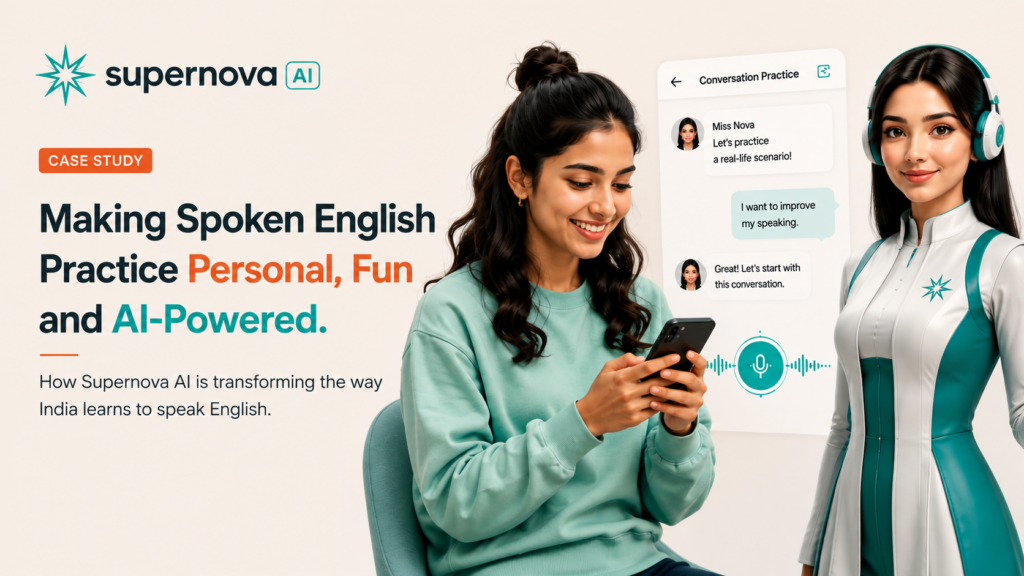
Learning to speak English is rarely about knowing one more grammar rule. The real challenge is having enough confidence to use English when the moment arrives – during an interview, at work, while meeting someone new, or in an everyday conversation. Supernova AI is built around that practical side of English learning, combining structured lessons, speaking practice, AI feedback, and multilingual support. Our challenge was to communicate that experience in a way that felt less like advertising an English-learning app and more like showing people a companion they could genuinely practise with.
Supernova AI is an AI-powered spoken English learning platform focused on helping learners build practical communication skills. Its current product communication highlights structured learning, real-world conversations, pronunciation support, grammar correction, vocabulary development, interactive exercises, and learning support through Indian languages. Its AI tutor, Miss Nova, provides conversational practice and personalised feedback, making speaking practice available without requiring a human teacher to be present.
The product is designed around a simple behavioural shift: learners should not only study English; they should use it.
That distinction is important because speaking requires practice. A learner can understand a grammar rule and still hesitate when asked a simple question in English. They can know vocabulary and still struggle to construct a sentence quickly. Supernova’s product experience addresses this through practice-oriented learning rather than treating English purely as a subject to memorise.
The platform’s capabilities include:
- Structured lessons that provide learners with a step-by-step learning path.
- Real conversations and role-play, giving learners opportunities to use English in practical situations.
- Pronunciation and grammar feedback, helping users identify and correct mistakes.
- Vocabulary and interactive speaking exercises designed around everyday communication.
- Indian-language support, making explanations and learning more accessible to users who are more comfortable beginning in their native language.
- Miss Nova, the 24/7 AI tutor, providing conversational guidance and feedback while users practise.
Supernova’s more recent technology story also demonstrates the importance of voice interaction for the product. In its 2026 customer story with Sarvam, Supernova describes Nova AI as a voice tutor designed for Indian learners, with support across 11 Indian languages and an emphasis on accurate, low-latency speech interaction.
The Communication Challenge
The English-learning category already has a familiar visual and advertising language.
A student looking at a language-learning advertisement often sees the same predictable pattern: a person struggling with English, a few motivational statements, a smiling teacher, some vocabulary, and finally an invitation to download an app.
The problem was not that these messages were incorrect. The problem was that they were forgettable.
For Supernova, simply saying “Learn English with AI” did not communicate the real personality of the product. It explained the category but not the experience.
We therefore needed to avoid communication that felt:
Too classroom-like: focused primarily on lessons and rules.
Too feature-heavy: listing AI capabilities without showing their relevance.
Too generic: using the same “improve your English” language used across the category.
Too motivational: promising confidence without demonstrating how practice creates it.
Too product-centric: showing an app screen without showing why a learner would actually use it.
The communication challenge became more specific: how do we make an AI-powered English-learning platform feel like something people can see themselves using in real life?
The answer could not simply be another product demonstration. It had to be a change in storytelling.
The Core Strategic Insight: People Don’t Want to “Learn English.” They Want to Speak It.
People don’t want to “learn English.” They want to speak it. This became the central strategic insight guiding the entire campaign.
Traditional communication often follows: Feature → Explanation → CTA. For example: “AI-powered pronunciation correction. Improve your pronunciation. Download now.”
We wanted to change the experience to: Real-Life Problem → Relatable Moment → English Barrier → Solution → Practice.
The difference is subtle but powerful. A learner is not necessarily thinking about “improving pronunciation” while sitting at home. They are thinking about what happened when they mispronounced a word in front of someone. They are not always worried about grammar as a concept. They are worried about saying the wrong sentence during an interview.
So instead of starting with the product, we started with the moment that makes the product relevant. That allowed Supernova’s features to appear naturally as solutions to situations learners already recognise.
Our Creative Approach: From “English Learning App” to “Everyday English Companion”
The strategic insight led to a broader creative shift: Supernova should not feel like another English-learning product sitting outside someone’s daily life. It should feel like a companion for practising the English they need in daily life.
Five principles shaped the approach:
Relatability
Start with situations learners recognise instead of abstract learning promises.
Simplicity
Use straightforward language and clear scenarios so the message does not become another English lesson.
Humour
Use small, recognisable mistakes and awkward moments to create attention without making learners feel embarrassed.
Localization
Reflect the linguistic and cultural reality of Indian learners rather than presenting English as a one-size-fits-all experience.
AI as the Solution
Let AI enter the story at the moment it is useful—when the learner needs an answer, correction, explanation, or opportunity to practise.
The Big Creative Idea: Make English Learning Look Like Real Life
The creative idea was simple: make English learning look like real life.
Instead of creating scenarios that felt like lessons, we created communication around situations where English naturally matters. For example:
- Speaking to someone at work
- Introducing yourself
- Preparing for an interview
- Asking for information
- Talking to a colleague
- Handling an everyday conversation
- Making a common grammar mistake
- Searching for the right word while speaking
- Translating a thought from a regional language into English
These situations immediately create a reason to care. The English lesson is no longer the starting point. The situation is. And Supernova becomes the tool that helps the learner handle it better.
Regional Storytelling
India does not have one single English-learning journey.
Learners come from different linguistic backgrounds, and many naturally move between their mother tongue and English. Supernova’s product supports that reality through Indian-language explanations and multilingual voice interaction; its current product materials highlight support for languages including Hindi, Tamil, Telugu, and Bengali, while its 2026 Sarvam case study describes voice support across 11 Indian languages.
We translated that product truth into a simple storytelling flow: Regional-language conversation → English communication problem → AI-powered practice → Improved confidence.
The regional language is not treated as an obstacle. It becomes the starting point. A character can think or speak naturally in their familiar language, encounter an English communication problem, and then turn to Supernova for help.
This makes the story culturally recognisable while also demonstrating why multilingual support matters. The result is communication that says: you don’t have to become someone else to learn English. You can start from where you are.
Character-Led Content: Meet Miss Nova
A major opportunity was Miss Nova, Supernova’s AI tutor.
Instead of presenting AI as an invisible technical feature, we treated the AI teacher as a recognisable character within the communication ecosystem. Miss Nova can correct, explain, guide, practise and respond. That makes the product behaviour easier to dramatise.
A learner makes a mistake. Miss Nova responds. The learner asks a question. Miss Nova explains. The learner struggles with pronunciation. Miss Nova helps them practise. The learner wants to try again. Miss Nova gives them another opportunity.
Supernova’s public product description specifically positions Miss Nova as a 24/7 AI teacher offering grammar corrections, pronunciation help, personalised feedback, and conversation practice.
Why Character-Led AI Content Worked
There is a major psychological difference between hearing “AI-powered English learning” and seeing “I can actually practise with her.”
The first describes technology. The second describes a relationship with the product.
A character gives abstract AI behaviour a face, personality, and role in the story. That makes an AI tutor easier to remember and gives content creators a recurring device for different scenarios. This is exactly the kind of narrative device good branding is built on — giving an abstract idea a face people can relate to.
Content Pillars
With the brand story established, we built content around repeatable territories rather than isolated ideas. The objective was to make every piece feel different while still reinforcing the same communication system.
Everyday English
Content centred on real situations where people need practical English: conversations at work, interviews, introductions, asking questions, everyday requests, social conversations, and speaking confidently in unfamiliar situations. The product becomes relevant because the situation is already familiar.
Common English Mistakes
Mistakes became a storytelling device rather than something learners should be ashamed of. The communication follows a simple structure: Wrong sentence → Why it’s wrong → Better sentence → Practice. This allows education to happen inside an entertaining moment. Rather than saying “Here are four grammar rules,” the content shows a mistake, explains it quickly, and gives the learner a sentence they can actually use.
AI Teacher
Miss Nova becomes the entry point for grammar corrections, pronunciation guidance, sentence improvement, conversational practice, explanations, and speaking feedback. The focus is always on the learner’s outcome rather than the AI technology itself.
Regional Comedy
Regional humour creates recognition. A learner hears a familiar phrase, behaves in a recognisable way, or translates something directly from their mother tongue. The resulting English sentence becomes the joke—and the learning moment. The humour makes the content shareable while the correction makes it useful.
Product Demonstration
The product should not be demonstrated as a screen recording alone. The narrative is: User speaks → AI responds → AI corrects → User learns. This lets the audience understand the product by watching it work.
Our Video Content Formula
A repeatable video structure made the content easier to produce and easier for audiences to understand:
Hook
Start with something that immediately catches attention.
Relatable Problem
Show a situation the target learner recognises.
Conflict
The learner struggles with a sentence, pronunciation, word, or conversation.
AI Intervention
Supernova or Miss Nova enters naturally.
Learning Moment
The incorrect communication is explained or corrected.
Practice
The learner tries again.
CTA
The product becomes the next step for continued practice.
This structure ensures the product is not introduced too early. First, create recognition. Then, create the problem. Then, show the solution.
From Product Features to Human Benefits
One of the biggest changes in communication was moving from technical product language to human outcomes.
Instead of “AI-powered pronunciation correction,” we communicate: “Know how the word should actually sound—and practise saying it.”
Instead of “Multilingual AI support,” we communicate: “Start from the language you’re comfortable with, then move into English.”
Instead of “Real-time AI conversation,” we communicate: “Practise the conversation before you have to have it for real.”
This approach gives every feature a human reason to exist. The feature remains important. But the benefit becomes the headline.
AI-Led Visual Production
Because the product itself is AI-powered, the visual language also needed to make room for AI without becoming visually overloaded. We explored visual storytelling devices such as:
- AI teacher representations
- Digital and holographic interfaces
- Conversational UI moments
- Stylised learning environments
- Human-and-AI interactions
- Product-focused phone screens
- Visual transitions between real-world situations and AI practice
The important distinction was that the visuals should support the story rather than become the story. The objective was never to make every frame look futuristic. It was to create a visual bridge between real human situations and AI-powered assistance.
The Role of Humour
Humour became an important mechanism for making educational content feel less like education. The communication flow is:
Humour → Attention
Relatability → Recognition
Learning → Value
Product → Solution
A funny mistake gives people a reason to stop. A familiar situation makes them recognise themselves. The correction gives the content practical value. Then Supernova appears naturally as the tool that enables further practice.
This balance prevents the content from becoming either a traditional educational lecture or entertainment with no product relevance.
What We Built
The creative system extended beyond individual videos. We built a connected communication framework comprising:
- A clear Supernova brand narrative around practical speaking confidence.
- A character-led content system built around Miss Nova.
- Regional storytelling frameworks that begin from Indian-language contexts.
- A set of repeatable content pillars for everyday English and learning situations.
- A structured video storytelling formula for short-form content.
- A feature-to-benefit communication framework that translates product capabilities into human outcomes.
- An AI-led visual language connecting real-life situations with the Supernova experience.
Together, these elements created a system that could keep generating content without losing the central brand idea.
The Transformation: Before & After
| Before | After |
|---|---|
|
English-learning app |
Everyday English companion |
|
Feature-led |
Experience-led |
|
Generic learning communication |
Real-life storytelling |
|
AI as technology |
AI as a helpful teacher |
|
English-first messaging |
Regional-language entry points |
|
Education-heavy |
Education + entertainment |
|
Product demonstration |
Human situation + product solution |
The transformation was not about changing what Supernova’s product does. It was about changing how people understand what the product does.
Business Communication Impact
The strategy created multiple communication routes without fragmenting the brand.
Comedy could attract attention. Education could deliver value. Character-led stories could make AI memorable. Regional storytelling could create cultural recognition. Product demonstrations could make the technology understandable.
Together, these formats support a single communication objective: making Supernova feel practical, accessible, and relevant to everyday speaking.
That consistency is particularly important as the product expands its voice-first and multilingual capabilities. Supernova’s 2026 technology case study reports that Nova AI serves more than 1 crore learners, with its voice infrastructure supporting 11 Indian languages; it also reports substantial increases in usage and engagement following its voice-stack improvements. These figures are Supernova’s published customer-story claims, not campaign performance claims from this content strategy.
The Result
The result was a communication system that moved Supernova away from the familiar visual language of English-learning advertising.
Instead of making the audience feel that they are looking at another language-learning app, the storytelling starts with moments they already understand: getting stuck while speaking, making a mistake, searching for a word, preparing for an interview, or needing to communicate confidently.
Supernova then enters the story as the practical solution.
The result is a more human way to communicate an AI product—one where technology does not dominate the narrative, but quietly enables the learner to practise, improve, and try again.
Key Takeaway
Supernova already had the technology to make English practice conversational, interactive, personalised, and accessible. The strategic opportunity was to make those capabilities feel human before asking people to understand the technology behind them.
By turning features into situations, AI into a character, regional language into an entry point, and mistakes into moments of humour, we created a story people could recognise themselves in.
Because the strongest AI communication is not always about showing how intelligent the technology is. It is about showing how much easier life can feel when that technology understands the person using it.
Frequently Asked Questions
What is Supernova AI?
Supernova AI is an AI-powered spoken English learning platform that combines structured lessons, conversation practice, feedback, and multilingual support for Indian learners.
How does Supernova AI help users improve spoken English?
Supernova AI helps users practise real conversations, receive grammar feedback, and improve speaking through an always-available AI tutor rather than relying solely on traditional lessons.
What is Nova AI in Supernova?
Nova AI is Supernova’s voice-based AI tutor that listens to learners, supports conversations, provides feedback, and helps users practise English more naturally.
Can Supernova AI support Indian languages?
Yes. Supernova’s voice experience supports multilingual interaction, including Indian languages, allowing learners to communicate naturally while practising English.
Why is regional-language support important for English learning?
Regional-language support reduces hesitation by letting learners ask questions and understand feedback in familiar languages before continuing their English-speaking practice.
How did the Supernova AI case study approach English-learning content?
The strategy shifted communication from feature-led advertising toward real-life situations, relatable communication problems, AI intervention, practical learning, and continued speaking practice.
Why did the strategy focus on real-life English situations?
Real-life scenarios make English learning immediately relevant, showing users how speaking skills apply during interviews, workplace conversations, introductions, and everyday interactions.
Why was Miss Nova used as a recurring character?
Miss Nova gives Supernova’s AI experience a recognisable personality, making corrections, explanations, conversation practice, and learning interactions easier to demonstrate through stories.
What content strategy was used for Supernova AI?
The strategy combined everyday English, common mistakes, AI-teacher content, regional comedy, product demonstrations, and short-form storytelling designed around relatable learner situations.
What was the main communication transformation for Supernova AI?
Supernova’s communication moved from generic, feature-focused English-learning messaging toward relatable, character-led, regional, and experience-driven storytelling.